
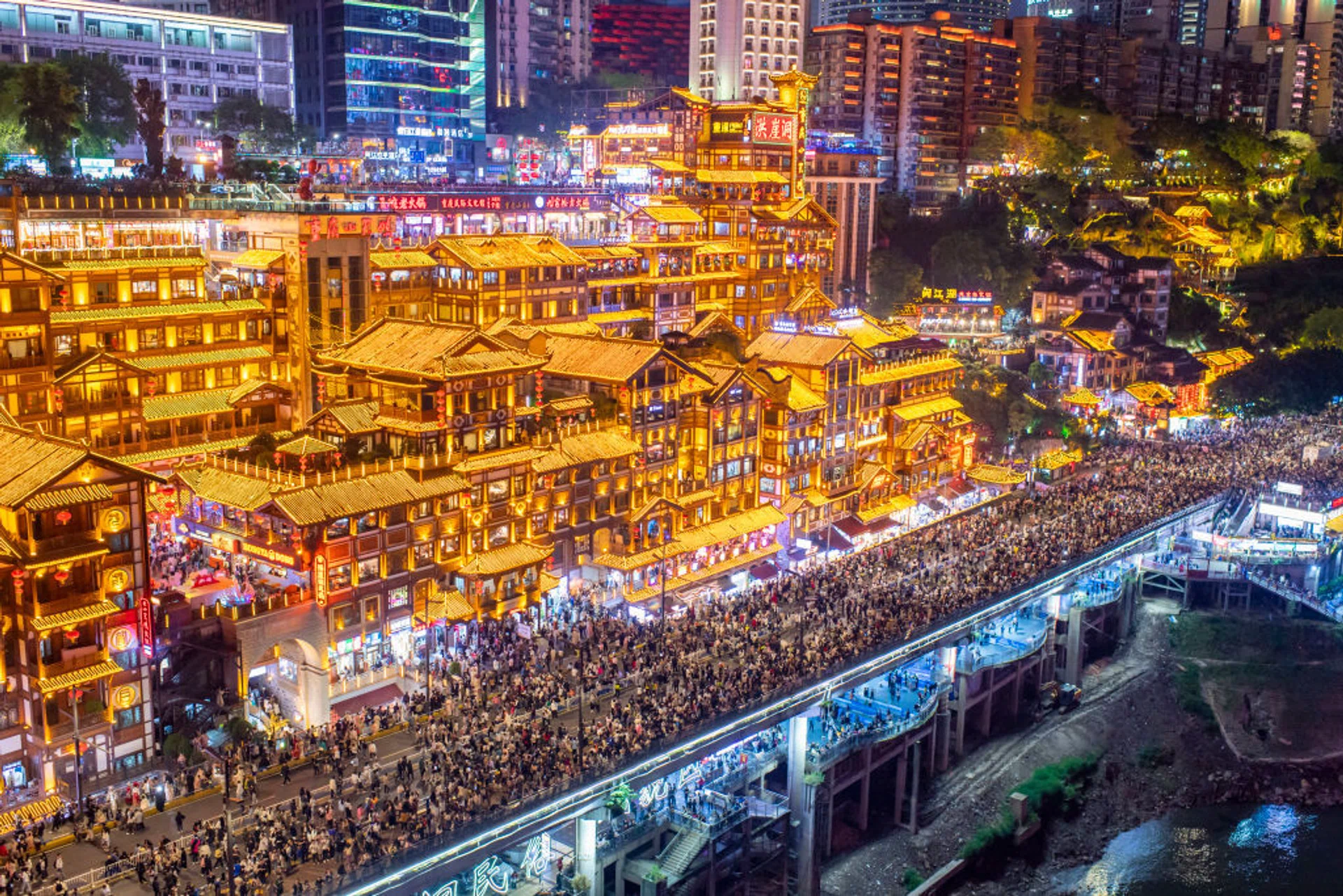
Built across steep hills at the meeting point of the Yangtze and Jialing rivers, this sprawling southwestern metropolis can feel almost futuristic. It’s a part of China where you’ll see skyscrapers rising from the mist and roads stacked across multiple levels.
But look beyond Chongqing’s dramatic skyline and you’ll discover a city with plenty of history and character. Centuries-old neighbourhoods sit alongside gleaming malls, while some of China’s most addictive food can be found in tiny noodle shops and hotpot restaurants.
We’ve rounded up several reasons why Chongqing is the next destination to visit in the China bucket list.
- 1. Get lost in Chongqing’s vertical city
- 2. Try the viral Chongqing motorcycle trend
- 3. Visit Hongya Cave’s sprawling complex of traditional-style buildings
- 4. Watch a monorail disappear into a building
- 5. Savour Chongqing hotpot
- 6. Start your morning with Chongqing xiaomian
- 7. Ride the Yangtze River Cableway
- 8. Wander through Ciqikou Ancient Town
- 9. Discover the Dazu Rock Carvings
- 10. Escape the city at Wulong Karst
- 11. Understand Chongqing at the Three Gorges Museum
Get lost in Chongqing’s vertical city
Baidu Maps can only prepare you so much for Chongqing. In this city, what appears to be the ground floor of a building from one entrance might turn out to be several storeys above street level from another.That’s because central Chongqing is built across an exceptionally hilly landscape. Pedestrian walkways cut through buildings, roads overlap one another and seemingly ordinary staircases can suddenly reveal enormous drops towards the river below.
Spend some time exploring central Yuzhong District on foot rather than simply travelling between attractions. Half the fun is discovering Chongqing’s hidden staircases, elevated walkways and unexpected viewpoints. You’ll realise that in this city, getting slightly lost is part of the experience!
Try the viral Chongqing motorcycle trend
Whether you find it cringey or cool, Chongqing’s motorbike trend has gone viral on Instagram thanks to its cinematic, cyberpunk-style videos. The videos typically take place along scenic riverside stretches like Nanbin Road and around landmarks like Hongyadong, featuring tourists riding pillion and performing small, choreographed dance moves on high-performance motorcycles against the city’s illuminated skyline.
Visit Hongya Cave’s sprawling complex of traditional-style buildings
Few sights capture Chongqing’s larger-than-life personality better than Hongya Cave. Built into a steep hillside overlooking the Jialing River, the sprawling complex of traditional-style buildings appears to tumble down the cliff across multiple levels.
By day, you can wander through its maze of restaurants, souvenir shops and snack stalls. But the real magic happens after dark, when thousands of lights illuminate the wooden facades against a backdrop of skyscrapers and bridges, looking like a real-life Blade Runner set come to life. For the best view, cross to the opposite side of the road or head towards Qiansimen Bridge, where you’ll get the full spectacle of Hongya Cave glowing against Chongqing’s skyline.
Watch a monorail disappear into a building
Chongqing’s unique geography has forced the city to get creative with its transport system, and nowhere is that more obvious than at Liziba Station. There, trains on Chongqing Rail Transit’s Line 2 appear to travel straight through the middle of a residential high-rise. Rather than the building being constructed around an existing railway, the station and residential block were designed together, with the station occupying several floors of the building.
There’s a viewing platform below the station where you can watch the trains glide in and out overhead. It may only take a few minutes, but it’s one of those wonderfully surreal Chongqing experiences you’ll struggle to find anywhere else.
Savour Chongqing hotpot
If Chengdu hotpot is fiery, Chongqing’s version turns things up another notch! Traditionally served in a metal pot divided into nine sections, the bubbling red broth gets its unmistakable flavour from chillies, Sichuan peppercorns and beef tallow.
If you have to pick one place, be sure to check out Pi Pa Yuan Shi Wei Fresh Hotpot. With 888 tables that seat over 5,800 guests, the restaurant is recognised in the Guinesss World Records as the largest restaurant in the world.
Order plates of thinly sliced beef, mushrooms, tofu and vegetables to cook at the table, alongside more adventurous local favourites like duck intestines and beef tripe. Expect the addictive combination of chilli heat and Sichuan peppercorns (be prepared to chug lots of water afterward). And don’t worry if your spice tolerance isn’t quite up to local standards. Ask for a “wei la” (mildly spicy) option, and keep a bowl of sesame oil nearby for dipping.
Start your morning with Chongqing xiaomian
Hotpot might get most of the attention, but one of Chongqing’s most beloved everyday foods is considerably simpler. Xiaomian, or Chongqing noodles, are typically served in a punchy mixture of chilli oil, Sichuan pepper, garlic and other seasonings, sometimes topped with minced meat or braised beef.
You’ll find small noodle shops serving bowls throughout the city, often from early in the morning. If you’re looking for a well-established place, make a beeline for Super Li Bandengmian or Mao Liang Chongqing Xiao Mian in the Yuzhong district. Some of the best meals also come from humble neighbourhood eateries where diners squeeze around small tables and finish their noodles in minutes.
Ride the Yangtze River Cableway
Before Chongqing’s extensive metro network made getting around considerably easier, the Yangtze River Cableway served as an important means of transport across the river. Today, the journey has become one of the city’s most popular sightseeing experiences.
The cable car carries passengers high above the Yangtze, offering sweeping views of the river, bridges and dense clusters of skyscrapers built along its banks. The ride itself is short, so try to go outside the busiest periods if possible. Visit around sunset and you’ll see Chongqing gradually transform from a hazy mountain city into a sea of lights — a particularly memorable introduction to why its nighttime skyline has become so famous.
Wander through Ciqikou Ancient Town
For a glimpse of historical Chongqing, head to Ciqikou Ancient Town. The settlement traces its history back hundreds of years and grew into an important commercial port along the Jialing River during the Ming and Qing dynasties.
Today, its stone-paved lanes are lined with traditional buildings, teahouses, restaurants and shops selling everything from chilli products to local handicrafts. It can get crowded, particularly around the main streets, so venture into the quieter side alleys to experience a more atmospheric side of the neighbourhood. Come hungry too, as Ciqikou is a great place to snack your way through Chongqing specialities while exploring.
Discover the Dazu Rock Carvings
The Dazu Rock Carvings remains one of the region’s most remarkable historical treasures. Spread across several sites in Chongqing’s Dazu District, the carvings include more than 50,000 statues, with the most significant works dating from the 9th to 13th centuries. Intricately carved into cliffs and caves, they depict Buddhist, Taoist and Confucian themes alongside vivid scenes of everyday life.
The carvings were inscribed on the UNESCO World Heritage List in 1999 and are considered among the finest examples of later Chinese grotto art. Baodingshan is particularly impressive, with enormous, detailed sculptures unfolding along the cliff face.
Escape the city at Wulong Karst
Chongqing’s dramatic landscapes don’t end at the city limits. Around 129km from central Chongqing lies Wulong, where towering limestone formations, caves and enormous natural bridges create scenery straight out of a fantasy film.
The highlight is the Three Natural Bridges, a series of three enormous limestone arches surrounded by sheer cliffs and lush vegetation. Together with Furong Cave and other formations in the area, Wulong forms part of the UNESCO-listed South China Karst. Take your time walking through the valley below the bridges. Surrounded by misty cliffs, it’s difficult to believe that one of China’s biggest cities is only a few hours away.
Understand Chongqing at the Three Gorges Museum
Located opposite the imposing Great Hall of the People, the museum’s permanent exhibitions explore everything from the ancient Ba-Yu civilisation and Chongqing’s development into a major city to the history of the Three Gorges. Its collections include archaeological finds, historic objects and material documenting the enormous changes brought about by the Three Gorges Project. It’s an especially worthwhile stop towards the beginning of your trip. Once you understand how geography, migration and history shaped Chongqing, you’ll gain a deeper appreciation for the extraordinary city.