ChatGPT, Claude, DeepSeek or Gemini? Which AI LLM works best for you?
Turns out, the answer is both more complicated than just feeding them the same question, and as simple as personal preference
By Karen Fong -
Share this article
AI is everywhere – it’s basically impossible to avoid it in your daily life. My husband uses ChatGPT every time we plan a holiday, a friend recently overhauled her skincare routine by giving Gemini details of all the products she wanted to finish and what she wanted to achieve, and another friend used Claude to create a specific kind of code for RSVPs to their wedding.
But does this have to do with preference or are specific AI Large Language Models (LLMs) better at certain tasks? Dr. Grandee Lee, from the School of Science and Technology at the SIngapore University of Social Sciences believes differences are quickly narrowing. “AI companies are very good at playing catch up. Claude from Anthropic is noted for longer, more nuanced reasoning and coding tasks. Gemini from Google benefits from deep integration with Google’s ecosystem and search infrastructure.”
Assistant Professor Lee Yi-Chieh, Director, AI 4 Social Good Lab, Department of Computer Science and School of Computing from National University of Singapore believes the differences are more practical depending on what you need in that instant. “Can it search the web? What other software does it plug into? Can it handle images, audio and video, or only text? How much can it read at once? How fast and expensive is it? What happens to your data afterwards?” He adds other reasons one might appeal over another could be how it “talks”, “since a model’s tone and style shape whether people want to keep using it. Those things, more than benchmark scores, decide which one fits into someone’s working life.”
To see how the different LLMs answer questions differently, I decided to test out my practical criticism skills from junior college literature class (waaaaay back when) and ask each LLM the same question. I then tried to analyse how they differed and which one seemed best.
Prompt: Create a 3-day itinerary for three girl friends in Seminyak Bali, we will be going end of August and want a mix of beach clubs, restaurants and spa.
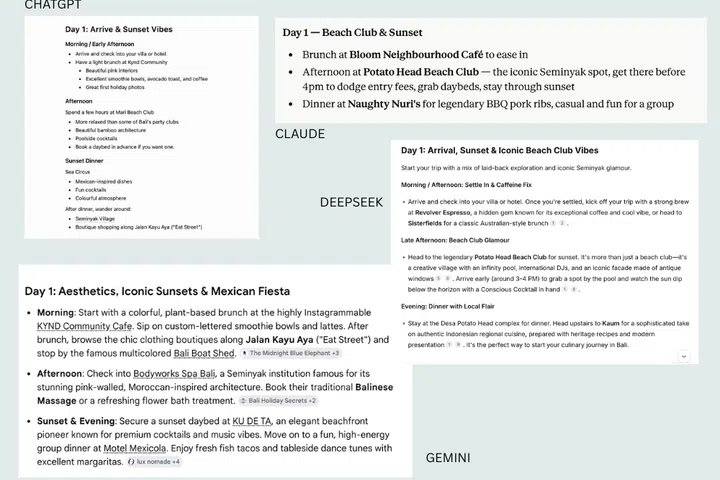
Honestly all four LLMs answered similarly for this and it probably wouldn’t matter which one you used for this question IMO. At most, it depends on how you prefer to be “spoken” to. I found the ChatGPT itinerary too brief without enough justification for its choices. Usually, when I ask it for something I will follow up by asking for references and links. One thing ChatGPT had over the others was it segued into costs and gave a rough estimate of how much everything would cost.
I preferred the format from both DeepSeek and Gemini, which I felt were concise but gave a bit of reasoning for their decisions. Gemini was my favourite because it also gave sources that I could check out or website links that I could continue to for booking. It also provided a map for the different locations. Having said that, DeepSeek also included a quick reference list of best restaurants and spas.
On to Qn.2…I tried to go for something more emotional and less practical. Stats have shown that AI models like ChatGPT are popular as therapy tools and so I was curious to see what it would say in this respect.
Prompt: It’s hard to make friends as an adult, what advice do you have for me as a 30-something Singaporean?
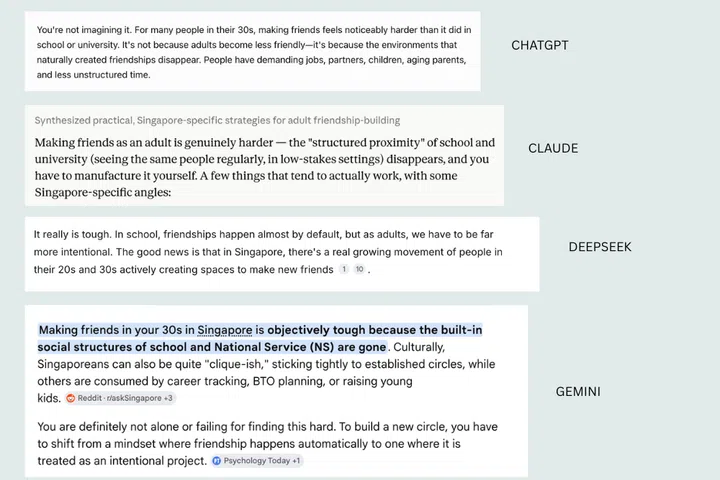
This was decidedly harder for me to analyse, in the sense that I realised determining which one was “best” would require me to go down a rabbit hole of emoting I hadn’t quite prepared for. I am not a lonely 30-something Singaporean, I am a tired, 40-something permanent resident mum. I was however impressed by how sympathetic they all were to my friendship plight, acknowledging and validating my feelings in a way no Asian parent ever would.
Frankly having used AI mainly for research, the answers it gave for my emotional problem sounded quite fake. I’m not sure I would really continue asking it questions to find an answer. I also feel it would take a long time for me to feel a “connection” of any sort with any of them (though DeepSeek probably felt the most approachable to me).
The emotional aspect of this question also highlights something Professor Lee calls AI-mediated relationships. “People are using AI to rehearse difficult conversations, make sense of social interactions, or even for companionship. There can be real value in it (for example, a safe space to practice, or comfort for someone who is lonely), but research also points to risks, including weaker social skills and, for some people, decline in well-being, for people who rely heavily on AI.”
For question three, and with my deadline looming, I decided to just ask the four LLMs which one they thought was better.
Prompt: Between ChatGPT, Claude, DeepSeek and Gemini, which is the most accurate LLM?
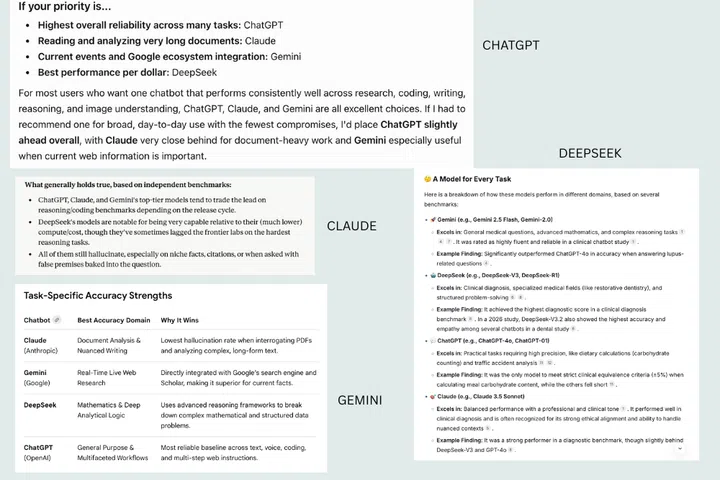
I found it funny that ChatGPT basically said it was the best – but then Claude, DeepSeek and Gemini pretty much said the same thing! I thought it was interesting that Claude acknowledged its own biasness when answering the question, and also pointed me to a crowd-sourced, AI evaluation platform or suggested I check out a hallucination leaderboard (which benchmarks and measures these LLMs on their tendency to give factually incorrect or unsupported information).
Hallucinations can be tricky, as the “ultimate people pleaser”, LLMs tend to want to give you the right answer and can spiral into make believe as a result. But Dr. Lee of SUSS says this is more a user-issue, not the AI. “We consistently give these models too little context and then wonder why the answers feel off or fabricated. If a stranger walked up to you on the street and asked “what should I do about my situation?”, you would have no idea where to begin. You would ask clarifying questions, you would want background, etc. The model, rather than admitting it does not have enough to go on, will sometimes fill in those gaps with plausible-sounding but inaccurate information.”
Professor Lee highlights also adds that whatever you choose, confidence should make you cautious. “The model that appears the most confident may not necessarily be the most reliable. Research shows these systems are often most convincing when they’re wrong, and people tend to trust a confident tone too readily.”
Overall, he says the model that has the “best answer” is the one that shows its work, separates fact from interpretation and links back to original sources. “There are also techniques being developed to make this more reliable. One is “retrieval-augmented generation”, in which the systems first look up relevant documents and answers from them rather than from memory. These techniques will keep improving, but they reduce the problem rather than solve it.”
Using AI for the right reasons
What this experiment showed (me, anyway) is that when it comes to using AI, you have to be very very specific. Treating it like an intelligent personal assistant, who nonetheless needs very clear and precise directions, is probably how you get the most out of it. A lot of good can come out of this specificity. Professor Lee describes how some of his students have turned AI into operating systems for daily living. “They use it to organise their studies, plan their extracurricular activities, stay on top of deadlines, and even decide where to eat. Others are building personal assistants that watch their social media feeds and surface the posts, opportunities, or conversations that match their interests.”
But he does caution about becoming too reliant on them. “I’m starting to observe a worrying trend, especially among students. Some lean on AI to generate ideas or finish work without trying to understand how or why the answer was reached. That is where over-reliance becomes a real concern.” He mentions the resulting lack of critical thinking as a main pain point. “When you hand the mental effort to a machine, you lose the practice that builds the skill in the first place. My view is that AI can be a useful coach or coordinator, but we should be careful about outsourcing our judgment, relationships, or sense of self to it.”
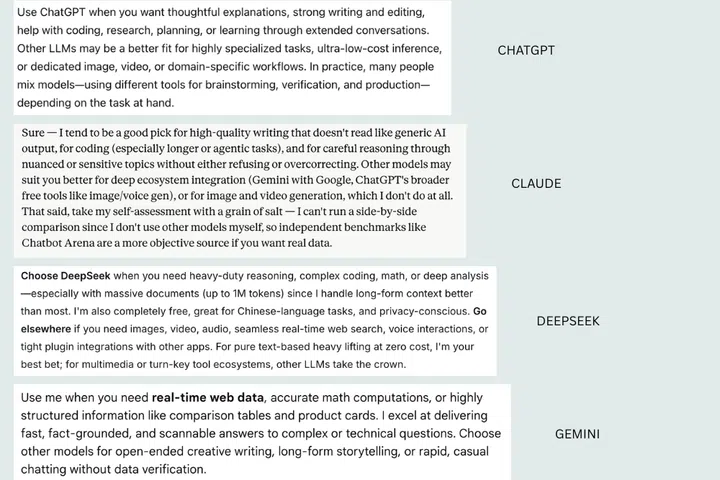
PS. For fun, I also asked each LLM the sell themselves and tell us why and when we should pick them, here are their very pageant queen answers: