%22%3E%3Cpath%20fill%3D%22%23000%22%20d%3D%22M79.702%2078.555c0%2033.03%2018.767%2046.361%2035.801%2046.361%2014.149%200%2029.738-7.033%2034.505-28.595l-1.445-.306c-3.61%2015.903-14.005%2027.371-33.06%2027.371-13.86%200-13.716-22.173-13.716-41.594V67.415h49.662c0-23.393-13.136-40.674-35.946-40.674-17.034%200-35.801%2018.94-35.801%2051.814m35.801-50.283c14.437%200%2014.005%2026.455%2013.861%2037.617h-27.573c-.004-18.353.865-37.617%2013.712-37.617%22%2F%3E%3C%2Fg%3E%3Cmask%20id%3D%22b%22%20width%3D%22603%22%20height%3D%22126%22%20x%3D%220%22%20y%3D%220%22%20maskUnits%3D%22userSpaceOnUse%22%20style%3D%22mask-type%3Aluminance%22%3E%3Cpath%20fill%3D%22%23fff%22%20d%3D%22M602.5%200H.5v125.074h602z%22%2F%3E%3C%2Fmask%3E%3Cg%20mask%3D%22url(%23b)%22%3E%3Cpath%20fill%3D%22%23000%22%20d%3D%22M86.81%20105.474h-1.445c0%2010.547-4.475%2011.463-5.483%2011.463-2.454%200-4.475-3.514-4.475-11.921V48.264c0-14.83-10.826-21.558-22.229-21.558-10.97%200-22.66%206.118-25.983%2017.276V8.478c-.515-4.763-4.26-8.48-8.893-8.48H.522v1.53H.5c2.886%200%204.763%201.988%204.763%205.045v110.211c0%203.057-1.877%205.045-4.763%205.045h.022v1.531h31.423v-1.531h.021c-2.885%200-4.762-1.988-4.762-5.045V50.252c0-10.395%208.949-18.806%2016.31-18.806%205.338%200%209.813%204.13%209.813%2014.83v58.74c0%2013.909%207.796%2019.874%2016.165%2019.874%209.958.005%2017.318-6.418%2017.318-19.416%22%2F%3E%3C%2Fg%3E%3Cmask%20id%3D%22c%22%20width%3D%22603%22%20height%3D%22126%22%20x%3D%220%22%20y%3D%220%22%20maskUnits%3D%22userSpaceOnUse%22%20style%3D%22mask-type%3Aluminance%22%3E%3Cpath%20fill%3D%22%23fff%22%20d%3D%22M602.5%200H.5v125.074h602z%22%2F%3E%3C%2Fmask%3E%3Cg%20mask%3D%22url(%23c)%22%3E%3Cpath%20fill%3D%22%23000%22%20d%3D%22M225.911%2042.197c0-10.552-11.259-16.818-22.954-16.818-10.682%200-21.513%205.045-25.119%2016.975v-7.352c-.48-4.574-3.977-8.148-8.364-8.398h-18.322v1.53h-.022c2.886%200%204.763%201.99%204.763%205.046v81.371h.004c.293%204.814%203.942%208.633%208.509%208.846v.004h18.173v-1.53h.022c-2.886%200-4.763-1.989-4.763-5.045V48.62c0-10.552%209.094-19.269%2016.602-19.269%204.763%200%208.805%203.672%209.386%2012.693%200%206.881%204.619%2011.773%2011.119%2011.773%206.631%200%2010.966-4.587%2010.966-11.62%22%2F%3E%3C%2Fg%3E%3Cmask%20id%3D%22d%22%20width%3D%22603%22%20height%3D%22126%22%20x%3D%220%22%20y%3D%220%22%20maskUnits%3D%22userSpaceOnUse%22%20style%3D%22mask-type%3Aluminance%22%3E%3Cpath%20fill%3D%22%23fff%22%20d%3D%22M602.5%200H.5v125.074h602z%22%2F%3E%3C%2Fmask%3E%3Cg%20mask%3D%22url(%23d)%22%3E%3Cpath%20fill%3D%22%23000%22%20d%3D%22M234.434%2028.315c2.925%200%205.583%202.312%206.779%205.863l29.782%2089.218h1.597l20.61-61.852%2020.609%2061.852h1.598l29.781-89.218c1.196-3.556%203.855-5.863%206.78-5.863h.183v-1.776h-11.538v1.776h.184c2.925%200%203.99%202.312%202.794%205.863l-18.082%2054.209-18.082-54.209c-1.196-3.556-.131-5.863%202.794-5.863h.183v-1.776h-33.343v1.776h.183c2.925%200%205.583%202.312%206.78%205.863l8.373%2025.058-9.705%2029.15-18.082-54.208c-1.196-3.556-.131-5.863%202.794-5.863h.184v-1.776h-33.344v1.776z%22%2F%3E%3C%2Fg%3E%3Cmask%20id%3D%22e%22%20width%3D%22603%22%20height%3D%22126%22%20x%3D%220%22%20y%3D%220%22%20maskUnits%3D%22userSpaceOnUse%22%20style%3D%22mask-type%3Aluminance%22%3E%3Cpath%20fill%3D%22%23fff%22%20d%3D%22M602.5%200H.5v125.074h602z%22%2F%3E%3C%2Fmask%3E%3Cg%20mask%3D%22url(%23e)%22%3E%3Cpath%20fill%3D%22%23000%22%20d%3D%22M377.826%20124.491c17.034%200%2038.211-15.699%2038.211-48.882%200-33.03-21.177-48.73-38.211-48.73-17.035%200-38.067%2015.857-38.067%2048.73.004%2033.026%2021.032%2048.882%2038.067%2048.882m0-96.085c13.86%200%2016.121%2028.24%2016.121%2047.356%200%2019.116-2.261%2047.198-16.121%2047.198-13.861%200-15.978-27.777-15.978-47.198%200-19.422%202.122-47.356%2015.978-47.356%22%2F%3E%3C%2Fg%3E%3Cmask%20id%3D%22f%22%20width%3D%22603%22%20height%3D%22126%22%20x%3D%220%22%20y%3D%220%22%20maskUnits%3D%22userSpaceOnUse%22%20style%3D%22mask-type%3Aluminance%22%3E%3Cpath%20fill%3D%22%23fff%22%20d%3D%22M602.5%200H.5v125.074h602z%22%2F%3E%3C%2Fmask%3E%3Cg%20mask%3D%22url(%23f)%22%3E%3Cpath%20fill%3D%22%23000%22%20d%3D%22M490.482%2042.197c0-10.552-11.258-16.818-22.953-16.818-10.683%200-21.513%205.045-25.119%2016.975v-7.352c-.48-4.574-3.977-8.148-8.365-8.398h-18.326v1.53h-.022c2.886%200%204.763%201.99%204.763%205.046v81.371h.004c.293%204.814%203.943%208.633%208.509%208.846v.004h18.173v-1.53h.022c-2.885%200-4.763-1.989-4.763-5.045V48.62c0-10.552%209.094-19.269%2016.602-19.269%204.763%200%208.806%203.672%209.386%2012.693%200%206.881%204.619%2011.773%2011.119%2011.773%206.64%200%2010.97-4.587%2010.97-11.62%22%2F%3E%3C%2Fg%3E%3Cmask%20id%3D%22g%22%20width%3D%22603%22%20height%3D%22126%22%20x%3D%220%22%20y%3D%220%22%20maskUnits%3D%22userSpaceOnUse%22%20style%3D%22mask-type%3Aluminance%22%3E%3Cpath%20fill%3D%22%23fff%22%20d%3D%22M602.5%200H.5v125.074h602z%22%2F%3E%3C%2Fmask%3E%3Cg%20mask%3D%22url(%23g)%22%3E%3Cpath%20fill%3D%22%23000%22%20d%3D%22M602.5%20103.974h-1.445c0%2010.553-4.474%2011.468-5.483%2011.468-2.453%200-4.474-3.519-4.474-11.925V6.585c0-3.056%201.877-5.045%204.762-5.045h-.166V.01h-17.715c-4.942%200-8.953%204.24-8.962%209.475h-.009v23.333c-6.063-3.977-9.84-5.503-16.48-5.503-17.034%200-35.801%2014.169-35.801%2047.046%200%2033.183%2013.101%2050.718%2035.801%2050.718%208.085%200%2013.302-2.294%2019.942-8.254%203.03%204.587%207.797%206.575%2012.704%206.575%209.966-.004%2017.326-6.427%2017.326-19.426m-30.75%2011.625c-4.763%204.435-10.84%205.822-13.38%205.822-11.482%200-19.558-16.933-19.558-46.907%200-29.97%2010.914-43.222%2019.885-43.222%203.3%200%206.264.153%2010.307%203.057v69.172c.004%205.04%201.017%209.017%202.746%2012.078%22%2F%3E%3C%2Fg%3E%3Cmask%20id%3D%22h%22%20width%3D%22603%22%20height%3D%22126%22%20x%3D%220%22%20y%3D%220%22%20maskUnits%3D%22userSpaceOnUse%22%20style%3D%22mask-type%3Aluminance%22%3E%3Cpath%20fill%3D%22%23fff%22%20d%3D%22M602.5%200H.5v125.074h602z%22%2F%3E%3C%2Fmask%3E%3Cg%20mask%3D%22url(%23h)%22%3E%3Cpath%20fill%3D%22%23000%22%20d%3D%22M516.984%20121.865c-2.885%200-4.763-1.988-4.763-5.045V9.466C512.2%204.241%20508.196.01%20503.259.01h-17.724v1.53h-.022c2.89%200%204.763%201.989%204.763%205.045v108.418c.515%204.564%204.029%208.129%208.434%208.337v.06h18.252v-1.53h.022z%22%2F%3E%3C%2Fg%3E%3C%2Fsvg%3E)

Tan Su Shan reached the top. Then, she sent the elevator back down
She is the first woman in DBS’ history to become CEO, but this milestone is just her opening line. As AI reshapes finance at a disorienting pace, Su Shan is steering the bank through its next great disruption. Her lasting legacy, though, may be the women she lifts along the way
By Sophie Hong -
Share this article
It’s hard not to be intimidated by Tan Su Shan. As Singapore’s most visible CEO, her reputation precedes her. Her more than 35 years in banking has resulted in a resume stacked with accolades, including ranking sixth globally (and top in Asia) on Fortune’s 2026 “Most Powerful Women in Business” list, and 29th on last year’s Forbes Power Women list.
In person, she’s petite – but her presence is anything but. Her voice is crisp and commanding, faintly accented by years in England where she studied and worked. We meet on the 46th floor of Marina Bay Financial Centre, in a meeting room lined with floor-to-ceiling windows. She takes her seat at the head of the table, with the Singapore skyline stretching out behind her back. The visual framing feels powerful, striking – and apt.
As CEO of DBS – a role that she assumed last March after 15 years at the bank – her job is to drive the institution towards continuous innovation and growth, and lead the 40,000-strong workforce behind it.
“We’re living in a time of massive change,” she states. “And it’s coming from all fronts.” She counts them off: geopolitical, market, interest rates, foreign exchange, capital markets, private markets, and now, prediction markets. A breath, then: “Crypto market, stablecoin. What next?”
Change, she observes, is happening at an “unprecedented pace”, accelerated by artificial intelligence (AI). This is where, she believes, leadership is crucial.
“As with every revolution… new jobs and new roles will be created, and there will be new GDP growth,” she explains, acknowledging the fears of job insecurity, especially among youth. “As leaders, we need to create hope, optimism, and the ability for humans to retrain and upskill themselves.”
Coming from Singapore’s most visible CEO, these words carry weight. Media monitoring and research company Carma’s latest CEO Media Analysis Report found that among all the chief executives here, Su Shan leads the pack on visibility, favourability, and headline mentions.
It’s a remarkable position for someone who, almost four decades ago, walked into DBS as an intern.
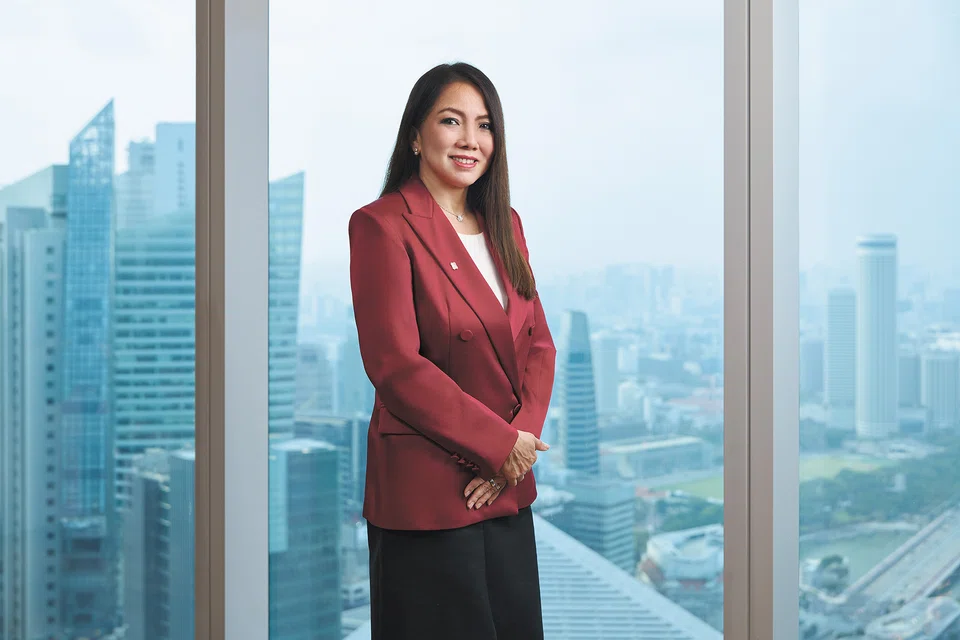
From intern to CEO
Her appointment as CEO feels like a full-circle moment. Her first-ever internship was with DBS, on the Initial Public Offering (IPO) floor. Then just 19 years old, she was tasked with handing out prospectuses at Raffles Place MRT station. “They were very thick books, very heavy!” she recalls, laughing. It was her first brush with capital markets.
Her first summer internship in London took her to the trading floor of Barings Securities. “That’s when I saw all these screens of stocks, bonds and FX (foreign exchange). I was like, what is all this? I want to learn.” She knew, right there and then, that she wanted to work in finance.
“I like maths. I like numbers. And I did economics, so I love to look at correlations,” shares Su Shan, who graduated from Oxford University with a master’s degree in politics, philosophy and economics. “Believe it or not, I like looking at balance sheets. But I also love looking at why things move. I was drawn by the wonderment of global capital markets.”
Her first job, at 21, was at Barings in London. They needed someone who spoke Mandarin and Japanese to work on its Asian derivatives desk. The floor ran on aggression: phones flying, tempers fraying, voices raised without warning. During her first week, she was yelled at so viciously that she locked herself in the bathroom and cried. But she didn’t quit.
Su Shan’s display of resilience as a young Asian woman in the male-dominated world of finance wouldn’t surprise those who know her – especially not her mother, retired pharmacist Rose Chan.
“She’s quite adaptable,” she says, recalling how, even as a girl, learning came easy to Su Shan, who picked up new skills rather quickly, whether it was swimming or playing the piano. “She achieved her grade 8 (an advanced level in piano) with no effort!” Rose recounts with a laugh, adding that she never had to worry about her younger daughter. “I had a lot of confidence in her.”
At Barings, Su Shan quickly rose through the ranks. Her job as a trader brought her places – first to Tokyo, then Hong Kong. Then in February 1995, at 27, her life – in her own words – “went to pieces” in the space of a single week. First, her then-fiance ended their seven-year relationship. Then Barings collapsed on Friday, brought down by a Singapore-based trader who had racked up £827 million in unauthorised losses. On Saturday, her landlady refused to renew her apartment lease – word of the collapse had already reached her.
“By Sunday, my life looked really bleak,” Su Shan says wryly. “It was painful, I went through four months of hell.” But eventually, something shifted. She still had her health. Her family. Her friends. Put that way, she told herself, life wasn’t so bad.
That setback turned out to be nothing more than a blip. Barings was absorbed by ING, where Su Shan continued and worked her way up to associate director. She was paid well and had a good title, with a strong client base in institutional banking. By most measures, she had made it.
Then, in 1997, Su Shan gave it all up.
“I felt my old job was being disrupted by machines,” she explains. Bloomberg and e-mail were creeping into the trading floor, and her clients were requesting for reports over voicemail or e-mail, instead of face time. She saw where it was heading. So she quit – not for another senior role, but to start over in private banking at Morgan Stanley.
“I gave up all my clients, my title, my pay. Downgraded back to associate. I was the oldest associate in the room, at 29 years old,” she recalls. Three years later, she was promoted to executive director. It came as a bit of a surprise, given that she was then eight months pregnant with her second child.
To her long-time friend, leading dermatologist Dr Patricia Yuen, none of this is new – just a grown-up version of the girl she’s always known since Nanyang Kindergarten, CHIJ St Nicholas, and Hwa Chong Institution. Even then, Su Shan excelled at everything she touched. She represented the school in swimming and debate competitions. Add to that a natural charisma, and the trajectory was never really in question.

Tan Su Shan (third from left) was part of the St Nicholas team that won the English and Chinese sections of the Singapore National Institute of Chemistry speech contest in 1983.
“She was very popular with the teachers, principal, and all her friends. She was also on the prefectorial board,” Dr Yuen shares. “And she did all of this while maintaining straight A’s.”
When asked if her friend is ambitious, Dr Yuen shakes her head. “I think that’s just her character,” she says with a knowing smile. “She’s always very determined, very hard-working. And when she sets her mind to something, she gets it done.”
In 2005, Su Shan moved to Citi Private Bank. That was where she crossed paths with Piyush Gupta, who would later go on to become DBS’ longest-serving CEO.
Speaking to Her World, Piyush fondly recalls his initial impression of Su Shan. “I used to love the energy she brought to the job,” notes the retired banker. Some months after his appointment as DBS’ CEO, Piyush realised he needed someone who had the vision and drive to help him build the bank’s wealth business. The first name that he thought of was Su Shan’s.
“I really needed someone who could work with people, apart from knowing the domain,” says Piyush of the decision. There was only one issue – Su Shan was back at Morgan Stanley, as managing director and head of private wealth management for South-east Asia.
“Attracting someone from Morgan Stanley to DBS was not obvious at that time,” Piyush recounts with a small grin. His elevator pitch to her consisted of two points: First, it was time for her to do what he jokingly calls “national service” at the Singapore bank, and secondly, it was an opportunity for her to lead the business, so she could really make an impact. Su Shan resigned the very next day. “It was a pleasant surprise,” Piyush says.
When his retirement was announced in 2024, Su Shan was named his successor. It was the first time that DBS had filled the role from within.
“She had demonstrated leadership and track record for delivery, and was deeply immersed in the DBS culture and way of working,” adds Piyush. “I am delighted that my confidence is proving justified.”
The view from the top
Her World first met and profiled Su Shan at 36, after she had set up the Financial Women’s Association Singapore (FWA). She was then an executive director at Morgan Stanley, and a young mother with two preschool-aged children. Dubbed a “hot shot”, she was, in the words of that article, a woman with the world at her feet.
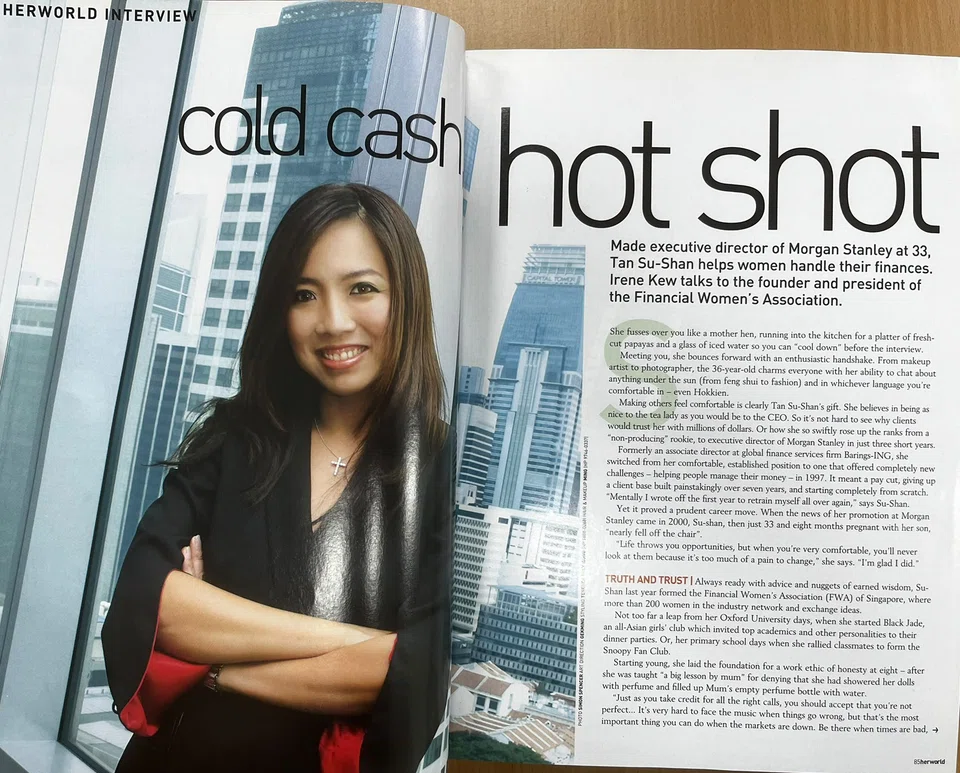
Su Shan first feature profile in Her World, November 2003
Today, at 58, her achievements have crossed a new territory entirely. In her first year as CEO, DBS reported a record pre-tax profit of $13.1 billion. Last June, the bank’s market capitalisation topped US$100 billion for the first time. This July, DBS reached $200 billion in market capitalisation – the first Singapore-listed company to do so – placing it among the top 20 banks globally by market capitalisation. An August report by Forbes’ noted that the bank’s stock has risen by 60 per cent since she took the reins, outpacing the benchmark Straits Times Index – a clear indication of investor confidence in her leadership.
It would be easy, at this altitude, to lose touch with the younger end of her workforce, but Su Shan seems determined not to. She has publicly pledged to welcome more than 500 young local hires into DBS through its Management Associate, Internship, and Traineeship programmes. Once a month, she runs a session dubbed “Spark Ideas with Su Shan”, where junior employees get face time with her to pitch whatever’s on their mind.
Shannah See, now head of Senior Client Partner (North Asia), DBS Private Bank, was a junior staffer when she first worked with Su Shan – then just three months into the job herself. Shannah recalls telling her new boss she was applying for marriage leave, expecting nothing more than a congratulatory word, or at most, the customary ang pao (red packet).
To her surprise, Su Shan was right there, in the pews of the church on a Sunday afternoon, bearing witness to her junior staff’s personal life milestone. She even gifted Shannah with a pair of gemstone earrings.
“That was 16 years ago, and I’ve never forgotten that gesture,” says Shannah. “It wasn’t just about showing up – it reflects the kind of leader she is. She makes people feel seen and never overlooks anyone, regardless of seniority.”
Navigating disruption
The next great professional challenge for the celebrated banker is, without a doubt, steering DBS through the disruption AI is about to bring. “Our vision is to be the best AI-enabled bank with a heart,” she states. “In a world driven by machines, it’s so easy to forget to be human-centred. You need to put the human in the heart of everything you do.”
Things are moving fast. Last year, DBS’ data analytics and AI/machine learning initiatives generated $1 billion in economic value. And as of June this year, the bank runs 26,000 personal agents – a 13-fold increase since it started its agentic journey less than a year ago.
“Soon, we’ll have more agents than humans,” Su Shan says with a small chuckle. “I’ve got to figure out how to manage the agent-human equation.”
She emphasises: “It’s new – to me, to everyone. In a new environment, I have deep faith in the human ability to be malleable.” It’s about the attitude, she stresses, not age.
“If you’re a young associate with a great attitude, I’d want to hire you, because you can be armed with AI. You’ll be very valuable to me.”
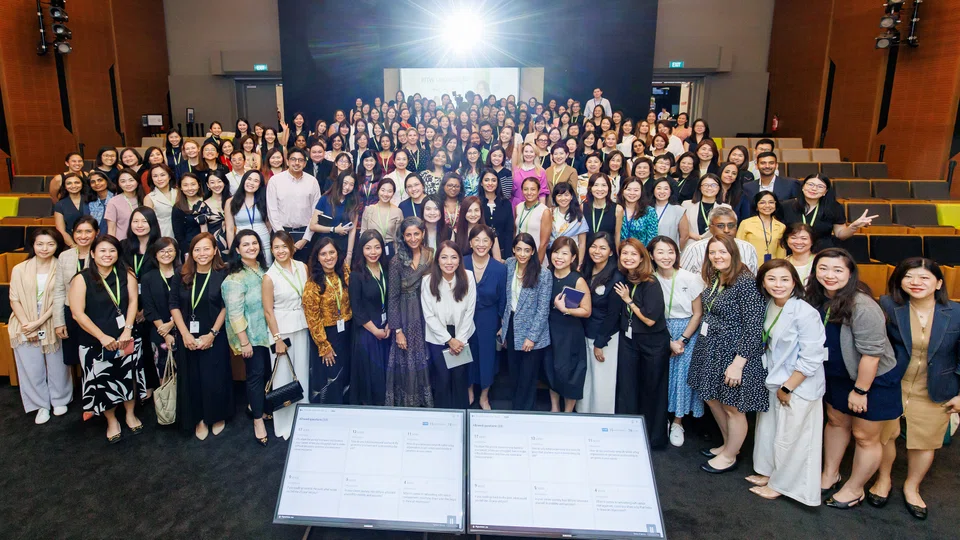
Su Shan (centre, in white) founded the Financial Women’s Association Singapore in 2001 to form a community that will develop and encourage females in the industry
Lifting as she leads
If leading DBS is Su Shan’s defining achievement today, her second may be one she built from nothing, back in 2001.
“There were a lot of women in the financial industry then, but we didn’t have the network to help each other,” she recalls. That motivated her to establish Financial Women’s Association Singapore (FWA), and funding all of the start-up expenses out of her own pocket. What started as a group of 12 to 15 like-minded women in banking, who generously volunteered their time after work, quickly grew.
Today, the FWA counts roughly 200 individual members and 30 corporate members, spanning organisations from Singapore Exchange to Blackrock. This year marks its 25th anniversary.
“It’s much bigger than I envisaged. And every female president that came along the way has gone on to bigger, better things. That’s what makes me so proud,” she beams. She’s quick to credit others too: the men who’ve championed FWA, including Piyush and SGX Group’s Loh Boon Chye, and sponsors like Goldman Sachs, JP Morgan and DBS.
Her purpose with FWA, she shares, was two-fold: to build a network for women in finance – one that could also support those who take career breaks for caregiving – and to give young women a shot at leadership, whether or not they held a leadership title in their day job.
When asked why she’s such a strong champion of mentorship, though, Su Shan is quick to correct the framing. “Female mentorship. I’ve been a strong advocate for women,” she says. Why the distinction?
“Men need support just as much as women,” Su Shan clarifies. “But women do have the heavier burden of both childcare and eldercare. That’s the issue.”
That distinction shapes who Su Shan chooses to invest in. Some would be surprised to learn that it extends well beyond the trading floors and boardrooms of finance. Rachel Lim, founder of home-grown fashion label Love, Bonito, is proof of that reach. The two first crossed paths in 2017, on a panel where they were both speakers.
“At that point, I knew of her reputation, but what struck me wasn’t her impressive resume,” shares Rachel. “It was the way she carried herself. She had this rare combination of confidence and humility. She spoke with such clarity and conviction, yet there wasn’t a hint of ego.”
The impression stuck. Rachel remembers leaving that panel thinking: I want to learn from this woman. Not long after, she reached out to Su Shan, who readily agreed to mentor her. “Over the years, she’s become someone I turn to whenever I’m navigating big leadership decisions or difficult seasons,” Rachel lets on.
When asked what she admires most about Su Shan, Rachel doesn’t point to her long list of accolades. Instead, it’s how she chooses to show up as a leader.
“She approaches the world with the curiosity of a beginner, despite having the wisdom of someone who’s spent decades leading at the highest level,” Rachel says. “I think that’s one of the reasons she continues to evolve. She has never confused experience with arrival.”
A voice for motherhood
Long before egg freezing entered public conversation in Singapore, Su Shan was already fighting for it. As a Nominated Member of Parliament from 2012 to 2014, she was one of the earliest public figures to lobby for elective egg freezing – a position that raised some eyebrows.
“At the time, the Cabinet was slightly horrified,” she says, laughing at the memory now. It would take over a decade for the law to catch up: In July 2023, elective egg freezing was finally legalised for women aged 21 to 37, regardless of marital status.
“I was advocating to give married women a choice,” she says. Globally, people are having children late in life – and with it, come fertility struggles that are rarely spoken about openly. Su Shan has watched it play out among her own colleagues.
“I’ve gone through the trials and tribulations of my colleagues’ fertility journeys,” she shares, her tone softening. “And I celebrate with them when the baby arrives. It’s really nice to see.”

(Clockwise, from top left) Tan Su Shan, with her husband Christopher Wilson, mother Rose Chan, and son Kai Wilson. Su Shan’s dress, Longchamp
The career ladder, and the harder, less visible choices women make around it, is a tension Su Shan has lived, not just observed. Back in Her World’s first-ever profile of her, she spoke frankly about the juggling act of being a working mother: pumping in the office, taking client calls with a baby crying in the background, and catching up on work from home, in between nursing sessions. She was strict with her time – a hard cut-off for work, with evenings kept for her children, and weekends reserved for workouts and yoga class with her husband, Christopher Wilson.
“When I became a mum for the second time, I realised it wasn’t easy to have your foot on the career ladder and be a present mum,” she admits. But speak to her family, and a different picture emerges – of a woman who didn’t just manage, but thrived.
“She is a wonderful mother, and there has never been a dull moment in my life since I met her,” says Christopher, founder of the Water and Healthcare Foundation, a non-profit serving rural communities in Cambodia. They first met the very evening Su Shan lost her job at Barings, at a commiseration party thrown by her ex-boss. Christopher, a guest that night, was instantly charmed. “She was wearing a purple mohair jumper, big eyes, very pretty,” he recalls of their first encounter. She, in turn, spotted his Harley-Davidson and simply said: “Nice bike.”
They’ve been married almost 30 years, and he’s had a front-row seat to her juggling act ever since they welcomed their first child in 1999 – when she famously brought her Bloomberg terminal into the delivery room to make an important trade. He still marvels at how she pulls all of it off.
“Every night she comes back, she has a smile on her face, as if she’s just been to the supermarket. It’s incredible,” he muses. “She has a tough job, but she never brings her work home. I find that extraordinary.”
Her daughter, Talisa Wilson, now 27, remembers a particular conversation they had when she was a teenager – one sparked by a debate with friends over whether having children would hold them back. That weekend, while in the car with her own mother, Talisa took the chance to probe.
“I asked her, ‘Mummy, when you had kids, did your life stop?’” she shares. Su Shan told her daughter it was the opposite – that was when her life started.

Su Shan and her family participate in annual humanitarian missions in Cambodia, with her husband’s Water and Healthcare Foundation
Sending the lift down
As much as Su Shan is a titan in the banking world, legacy, for her, was never going to be measured in numbers or accolades. It’s measured in whether her customers are better off. Whether her colleagues are better off. Whether the community is better off.
“That’s it,” she says plainly. “I just want to be remembered for whatever impact my team and I have made. That’s what drives me every day.”
She knows too, that a generation of young women is watching her, looking for a blueprint of what’s possible. Her advice to them is disarmingly simple: Go for it, and take the good with the bad. But above all, remember to uplift others.
“Don’t forget the people who are below you. Send the lift down.”
PHOTOGRAPHY Angela Guo
ART DIRECTION Adeline Eng
STYLING Felix Woei
HAIR Adelene Siow
MAKEUP Lasalle Lee using Cle de Peau Beaute
OUTFIT FOR FEATURED IMAGE Top, Max Mara. Leather skirt, Tod’s
ADDITIONAL REPORTING Amelia Chia