
Forget the power suit: This is what women in power are wearing now
From colourful tailoring to statement accessories, here’s how women are giving traditional office dressing a modern, more personal twist.
By Daniel Goh -
Share this article
For most of the 20th century, the fail-safe way for a woman to look powerful was to look, well, rather like a man. The codes were familiar: the dark suit, the severe shoulder, the curve disguising jacket, the low, discreet heel. Authority came in navy, charcoal and black, with distracting femininity absolutely subdued. The message was clear: If you wanted a seat at the big table, you had better dress to blend in with the men sitting around it.
That dress code has not exactly disappeared. But it is being rewritten. Look at the women now occupying some of the most consequential positions in public life and the picture is considerably more complex. Arguably, the evolution of female power dressing began with Margaret Thatcher, with her pussycat bow blouses and immaculate bouffant. Christine Lagarde, President of the European Central Bank, and erstwhile Director of the International Monetary Fund, meanwhile, wields undisputed power in watercolour Chanel jackets and signature brooches and earrings.
Closer to home, the new dress of power becomes still more individual. Singapore’s former president Halimah Yacob has moved comfortably between tailored suits and vibrant, elegant baju kurungs, finishing her looks with brooches and pearl necklaces; Indonesian diplomat Retno Marsudi, of ikat tops and statement pins; Tokyo governor Yuriko Koike is associated with her collection of Issey Miyake pleats.
None of these women needs to be a fashion icon to wield influence. Their significance lies in something more important: They have expanded the idea of what a woman in authority can look like. The crucial shift isn’t that powerful women have suddenly become more fashionable. It is that femininity itself is increasingly being decoupled from weakness. For generations, women entering positions of authority were required to perform a peculiar sartorial vanishing act. The feminine body was something to neutralise; the feminine wardrobe, a potential liability.
The “Dress For Success” power suit of the 1980s became a kind of gender camouflage. The square shoulders, rigid tailoring and masculine proportions offered women a way of signalling that they understood patriarchal rules — and, more importantly, that they would not be distracted by their own feminine nature.
Power dressing on the runway
Fashion, inevitably, has caught up with the times. The old power wardrobe borrowed heavily from the masculine playbook. For Fall/Winter 2026, designers are rewriting it. Structure, strong shoulders, sharp proportion and presence remain — but now they come filtered through colour, jewellery, softness and silhouettes that feel entirely her own.
At Dior, Jonathan Anderson’s new Bar jacket, perhaps the ultimate expression of Christian Dior’s feminine tailoring, is given a fluid, less assertive silhouette and paired with a statement skirt. The result is not the old HR-approved office jacket, but something altogether more commanding: a woman occupying her world on her own feminine terms. Chanel similarly takes the traditional shift dress and stretches it into something elongated and modern, while drop-waist skirts extend the silhouette with a new, elongated ease.
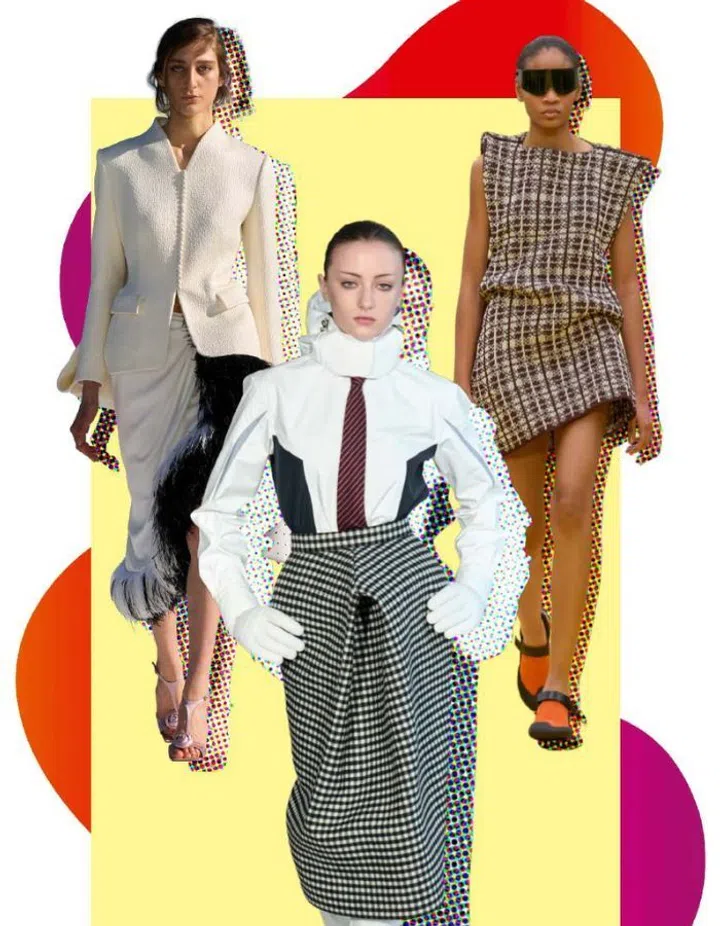
Left to right: Dior Fall/Winter 2026, Jean Paul Gaultier Fall/Winter 2026 & Loewe Fall/Winter 2026
There is none of the femme fatale femininity that once made dresses seem inappropriate for serious rooms. At Loewe, a checkered dress — we’re calling it this season’s new LBD — makes the case for the dress as a vehicle of authority in its own right. And at Celine, the exaggerated shoulder migrates from the blazer into a blouse. It is a particularly telling move.The shoulder, long shorthand for masculine power, no longer needs a suit around it to do the talking. Perhaps the most revealing shift of all: the codes of power are no longer confined to the severe tailored pantsuit.
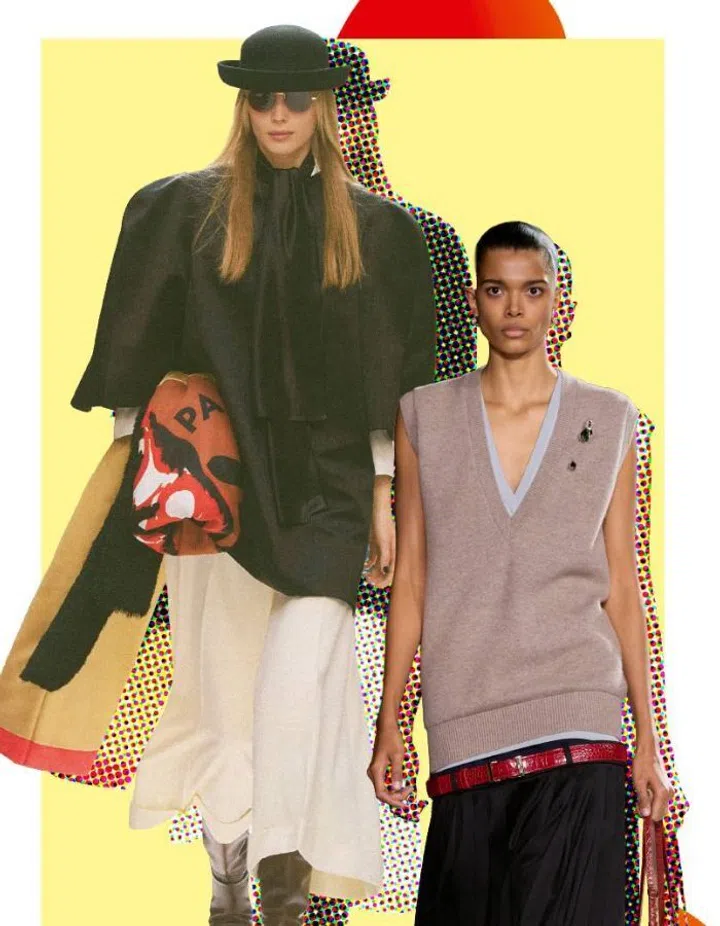
Left to right: Celine Fall/Winter 2026 & Chanel Fall/Winter 2026
Dress like a woman
The distinction matters because women in public life are still negotiating a formidable double bind. Dress too conservatively, like Japanese PM Sanae Takaichi, and a woman can appear conventional, micro-managing or overly cautious. Dress too femininely and she risks being judged as decorative, unserious or vain.
The Suffragette-era thinking may have loosened over a century, but they have not vanished: They are merely more Nuanced. The powerful woman can wear pastel, a deconstructed Bottega Veneta dress, baroque Chanel jewellery or Dior’s softer silhouettes.
What has changed is not simply the clothes, but the meaning of femininity itself: it can now be deliberate, visible and powerful — without requiring a woman to masculinise herself to be taken seriously. That is a subtle but profound shift. The old power suit said: “I am as good as a man.” The new power wardrobe says: “I do not need to be a man to be a leader.”
But perhaps, the most powerful thing a woman can wear now isn’t this asymmetrical coat or that Charvet shirt, but the confidence to make the clothes fearlessly her own.