%22%3E%3Cpath%20fill%3D%22%23000%22%20d%3D%22M79.702%2078.555c0%2033.03%2018.767%2046.361%2035.801%2046.361%2014.149%200%2029.738-7.033%2034.505-28.595l-1.445-.306c-3.61%2015.903-14.005%2027.371-33.06%2027.371-13.86%200-13.716-22.173-13.716-41.594V67.415h49.662c0-23.393-13.136-40.674-35.946-40.674-17.034%200-35.801%2018.94-35.801%2051.814m35.801-50.283c14.437%200%2014.005%2026.455%2013.861%2037.617h-27.573c-.004-18.353.865-37.617%2013.712-37.617%22%2F%3E%3C%2Fg%3E%3Cmask%20id%3D%22b%22%20width%3D%22603%22%20height%3D%22126%22%20x%3D%220%22%20y%3D%220%22%20maskUnits%3D%22userSpaceOnUse%22%20style%3D%22mask-type%3Aluminance%22%3E%3Cpath%20fill%3D%22%23fff%22%20d%3D%22M602.5%200H.5v125.074h602z%22%2F%3E%3C%2Fmask%3E%3Cg%20mask%3D%22url(%23b)%22%3E%3Cpath%20fill%3D%22%23000%22%20d%3D%22M86.81%20105.474h-1.445c0%2010.547-4.475%2011.463-5.483%2011.463-2.454%200-4.475-3.514-4.475-11.921V48.264c0-14.83-10.826-21.558-22.229-21.558-10.97%200-22.66%206.118-25.983%2017.276V8.478c-.515-4.763-4.26-8.48-8.893-8.48H.522v1.53H.5c2.886%200%204.763%201.988%204.763%205.045v110.211c0%203.057-1.877%205.045-4.763%205.045h.022v1.531h31.423v-1.531h.021c-2.885%200-4.762-1.988-4.762-5.045V50.252c0-10.395%208.949-18.806%2016.31-18.806%205.338%200%209.813%204.13%209.813%2014.83v58.74c0%2013.909%207.796%2019.874%2016.165%2019.874%209.958.005%2017.318-6.418%2017.318-19.416%22%2F%3E%3C%2Fg%3E%3Cmask%20id%3D%22c%22%20width%3D%22603%22%20height%3D%22126%22%20x%3D%220%22%20y%3D%220%22%20maskUnits%3D%22userSpaceOnUse%22%20style%3D%22mask-type%3Aluminance%22%3E%3Cpath%20fill%3D%22%23fff%22%20d%3D%22M602.5%200H.5v125.074h602z%22%2F%3E%3C%2Fmask%3E%3Cg%20mask%3D%22url(%23c)%22%3E%3Cpath%20fill%3D%22%23000%22%20d%3D%22M225.911%2042.197c0-10.552-11.259-16.818-22.954-16.818-10.682%200-21.513%205.045-25.119%2016.975v-7.352c-.48-4.574-3.977-8.148-8.364-8.398h-18.322v1.53h-.022c2.886%200%204.763%201.99%204.763%205.046v81.371h.004c.293%204.814%203.942%208.633%208.509%208.846v.004h18.173v-1.53h.022c-2.886%200-4.763-1.989-4.763-5.045V48.62c0-10.552%209.094-19.269%2016.602-19.269%204.763%200%208.805%203.672%209.386%2012.693%200%206.881%204.619%2011.773%2011.119%2011.773%206.631%200%2010.966-4.587%2010.966-11.62%22%2F%3E%3C%2Fg%3E%3Cmask%20id%3D%22d%22%20width%3D%22603%22%20height%3D%22126%22%20x%3D%220%22%20y%3D%220%22%20maskUnits%3D%22userSpaceOnUse%22%20style%3D%22mask-type%3Aluminance%22%3E%3Cpath%20fill%3D%22%23fff%22%20d%3D%22M602.5%200H.5v125.074h602z%22%2F%3E%3C%2Fmask%3E%3Cg%20mask%3D%22url(%23d)%22%3E%3Cpath%20fill%3D%22%23000%22%20d%3D%22M234.434%2028.315c2.925%200%205.583%202.312%206.779%205.863l29.782%2089.218h1.597l20.61-61.852%2020.609%2061.852h1.598l29.781-89.218c1.196-3.556%203.855-5.863%206.78-5.863h.183v-1.776h-11.538v1.776h.184c2.925%200%203.99%202.312%202.794%205.863l-18.082%2054.209-18.082-54.209c-1.196-3.556-.131-5.863%202.794-5.863h.183v-1.776h-33.343v1.776h.183c2.925%200%205.583%202.312%206.78%205.863l8.373%2025.058-9.705%2029.15-18.082-54.208c-1.196-3.556-.131-5.863%202.794-5.863h.184v-1.776h-33.344v1.776z%22%2F%3E%3C%2Fg%3E%3Cmask%20id%3D%22e%22%20width%3D%22603%22%20height%3D%22126%22%20x%3D%220%22%20y%3D%220%22%20maskUnits%3D%22userSpaceOnUse%22%20style%3D%22mask-type%3Aluminance%22%3E%3Cpath%20fill%3D%22%23fff%22%20d%3D%22M602.5%200H.5v125.074h602z%22%2F%3E%3C%2Fmask%3E%3Cg%20mask%3D%22url(%23e)%22%3E%3Cpath%20fill%3D%22%23000%22%20d%3D%22M377.826%20124.491c17.034%200%2038.211-15.699%2038.211-48.882%200-33.03-21.177-48.73-38.211-48.73-17.035%200-38.067%2015.857-38.067%2048.73.004%2033.026%2021.032%2048.882%2038.067%2048.882m0-96.085c13.86%200%2016.121%2028.24%2016.121%2047.356%200%2019.116-2.261%2047.198-16.121%2047.198-13.861%200-15.978-27.777-15.978-47.198%200-19.422%202.122-47.356%2015.978-47.356%22%2F%3E%3C%2Fg%3E%3Cmask%20id%3D%22f%22%20width%3D%22603%22%20height%3D%22126%22%20x%3D%220%22%20y%3D%220%22%20maskUnits%3D%22userSpaceOnUse%22%20style%3D%22mask-type%3Aluminance%22%3E%3Cpath%20fill%3D%22%23fff%22%20d%3D%22M602.5%200H.5v125.074h602z%22%2F%3E%3C%2Fmask%3E%3Cg%20mask%3D%22url(%23f)%22%3E%3Cpath%20fill%3D%22%23000%22%20d%3D%22M490.482%2042.197c0-10.552-11.258-16.818-22.953-16.818-10.683%200-21.513%205.045-25.119%2016.975v-7.352c-.48-4.574-3.977-8.148-8.365-8.398h-18.326v1.53h-.022c2.886%200%204.763%201.99%204.763%205.046v81.371h.004c.293%204.814%203.943%208.633%208.509%208.846v.004h18.173v-1.53h.022c-2.885%200-4.763-1.989-4.763-5.045V48.62c0-10.552%209.094-19.269%2016.602-19.269%204.763%200%208.806%203.672%209.386%2012.693%200%206.881%204.619%2011.773%2011.119%2011.773%206.64%200%2010.97-4.587%2010.97-11.62%22%2F%3E%3C%2Fg%3E%3Cmask%20id%3D%22g%22%20width%3D%22603%22%20height%3D%22126%22%20x%3D%220%22%20y%3D%220%22%20maskUnits%3D%22userSpaceOnUse%22%20style%3D%22mask-type%3Aluminance%22%3E%3Cpath%20fill%3D%22%23fff%22%20d%3D%22M602.5%200H.5v125.074h602z%22%2F%3E%3C%2Fmask%3E%3Cg%20mask%3D%22url(%23g)%22%3E%3Cpath%20fill%3D%22%23000%22%20d%3D%22M602.5%20103.974h-1.445c0%2010.553-4.474%2011.468-5.483%2011.468-2.453%200-4.474-3.519-4.474-11.925V6.585c0-3.056%201.877-5.045%204.762-5.045h-.166V.01h-17.715c-4.942%200-8.953%204.24-8.962%209.475h-.009v23.333c-6.063-3.977-9.84-5.503-16.48-5.503-17.034%200-35.801%2014.169-35.801%2047.046%200%2033.183%2013.101%2050.718%2035.801%2050.718%208.085%200%2013.302-2.294%2019.942-8.254%203.03%204.587%207.797%206.575%2012.704%206.575%209.966-.004%2017.326-6.427%2017.326-19.426m-30.75%2011.625c-4.763%204.435-10.84%205.822-13.38%205.822-11.482%200-19.558-16.933-19.558-46.907%200-29.97%2010.914-43.222%2019.885-43.222%203.3%200%206.264.153%2010.307%203.057v69.172c.004%205.04%201.017%209.017%202.746%2012.078%22%2F%3E%3C%2Fg%3E%3Cmask%20id%3D%22h%22%20width%3D%22603%22%20height%3D%22126%22%20x%3D%220%22%20y%3D%220%22%20maskUnits%3D%22userSpaceOnUse%22%20style%3D%22mask-type%3Aluminance%22%3E%3Cpath%20fill%3D%22%23fff%22%20d%3D%22M602.5%200H.5v125.074h602z%22%2F%3E%3C%2Fmask%3E%3Cg%20mask%3D%22url(%23h)%22%3E%3Cpath%20fill%3D%22%23000%22%20d%3D%22M516.984%20121.865c-2.885%200-4.763-1.988-4.763-5.045V9.466C512.2%204.241%20508.196.01%20503.259.01h-17.724v1.53h-.022c2.89%200%204.763%201.989%204.763%205.045v108.418c.515%204.564%204.029%208.129%208.434%208.337v.06h18.252v-1.53h.022z%22%2F%3E%3C%2Fg%3E%3C%2Fsvg%3E)

Quah Ting Wen: “If you keep trying to achieve someone else’s version of success, you'll never be truly happy”
Ahead of the upcoming Paris Olympics, national swimmer and three-time Olympian Quah Ting Wen reflects on the importance of having confidence in her journey – whether it’s bouncing back from setbacks or considering post-retirement life
By Cheryl Lai-Lim -
Share this article
Quah Ting Wen does not have a competitive streak – or so she says.
This is, of course, outside of the swimming pool. “I was always a little bit more clumsy on land,” says the 32-year-old national swimmer with a chuckle. “It’s probably because I spend so much time being so competitive in the pool, that anything else that I do elsewhere – such as academics or playing other sports with friends – I don’t get as upset when I lose.”
She pauses, before admitting affably: “At least, that’s what I think! My friends and family reading this might beg to differ.”
Within the pool, however, it’s a different story, as evidenced by her performance at the 2023 SEA Games. Held in May 2023 in Phnom Penh, Cambodia, the event saw the three-time Olympian bring home six golds and two silvers – she was also crowned best athlete at the Games for her achievements. It marked her ninth appearance and 60th medal at the SEA Games.
How it all began

Sports bra and Pure Boost sneakers, Adidas. Maxi skirt with slit, Ralph Lauren
Her journey into swimming began around the age of six, when her parents noticed her growing fascination with the water, and decided to enrol her in a survival course to ensure that she developed essential water safety skills. Following this, a swim coach recognised her potential, and offered her classes to pursue swimming further.
From then on, Ting Wen honed her abilities. By the age of eight, she had mastered all four primary swim strokes: breaststroke, front crawl, backstroke, and butterfly. She began her competitive journey at the age of 10, gradually ascending through the ranks of the national junior team, and later, the national team.
At 13, she represented Singapore in her inaugural appearances at both the World Championships and SEA Games. She continued to pursue swimming throughout her schooling years, representing Singapore and her schools at national and interscholastic competitions.
Upon graduating from the University of California, Los Angeles (UCLA) in 2014, where she majored in communication studies and film, she faced a pivotal decision: Should she commit to swimming full-time as a professional athlete, or quit and pursue a traditional career path?
She chose to compete. Her plan was to rigorously train in the two years leading up to the Rio 2016 Olympics. The competition was meant to mark Ting Wen’s graceful exit from Singapore’s national swimming team after 11 years of representation. However, she failed to advance to the semi-finals, and her lacklustre performance left her grappling with unanswered questions, and a deep desire to push herself further.
And so, Rio came and went. Ting Wen couldn’t bring herself to walk away. “After Rio, I realised that my passion for competitive swimming hadn’t waned. It was then that I began to take my career as a professional athlete more seriously,” she shares.
Choosing to commit to swimming full-time without a defined endpoint wasn’t easy for her, especially considering that Rio was meant to be “the end” of her swimming career. It didn’t help that many of her peers and classmates from school who had previously competed had since retired from swimming and transitioned into different phases of their lives.
“Back then, when I met my friends, there was a tinge of guilt and shame. We’d be talking about their new jobs and adventures, and things that they were trying out. When it was my turn to contribute to the conversation, it would just be, ‘Well, I’m still swimming’, you know?’”
For a competitive swimmer who has dedicated her life to move quickly in the water, she felt strangely stagnant in her life. “It felt like while they’ve moved forward and achieved various milestones, I’m still here, doing the same thing that I have been doing since I was eight,” she recalls. “I felt like I was missing out.”
Ting Wen has since accepted and embraced her role as a full-time athlete – though “it took some time”. “You learn, as you get older, that if you keep trying to achieve someone else’s version of success, you'll never be truly happy.” And swimming is what’s making her happy, says Ting Wen. “And so, I realised that if I was going to make a choice, I had better commit 100 per cent to it.”
The sacrifices of being a full-time athlete

Silk printed cropped top and pants, Ralph Lauren
With swimming being a year-round sport without an off-season, it’s crucial that professional swimmers keep up with their training regularly.
Ting Wen currently maintains a gruelling schedule six days a week: Up at 4.45am and in the water by 5.45am for training, where she swims until 7.30am or 8.00am. This is followed by an hour and a half of weight training. After a five- to six-hour break, where she’s “too physically exhausted to do much but nap or lounge around”, she returns to the pool at 4pm for another two- to three-hour session, often preceded by land drills and rehabilitation exercises.
While there are moments of exhaustion and frustration during training, the sense of fulfilment outweighs any transient discomfort. “There are days when it feels tough, when I question my progress,” she shares. “But sticking with it pays off. Reflecting on where I was a decade ago compared to now, seeing the growth and improvement, it’s incredibly motivating.”
Perseverance is indeed key in sports, and bouncing back from setbacks is part of the game. One such setback was when the Singapore women’s 4x100m swimming medley team was disqualified at the 2022 Hangzhou Asian Games, which was held from late September to early October 2023.
The day before the medley relay finals, Ting Wen, who was coming down with a bug and wasn’t feeling well, made a difficult decision: She decided to opt out of the individual 50m butterfly finals, to focus entirely on the relay match. “I felt like I only had one good swim left in me,” she explains. “I wanted to reserve all my energy for the relay.”
Her coaches supported her decision. The relay team, consisting of Ting Wen, her sister Jing Wen, as well as the Sim sisters, Levenia and Letitia, were ready. However, during the relay, Ting Wen jumped into the pool 0.1 seconds early during the handover from Jing Wen. As a result, the team wasn’t able to clinch the bronze medal.
The aftermath was fraught with self-doubt and remorse, compounded by the anguish of letting her teammates down. “The hardest part was hearing the girls’ happiness, witnessing their reactions, and then having it all stripped away in an instant,” she reminisces. “It left me grappling with a heavy burden of guilt and regret.”
Ting Wen took to Instagram to apologise for her error. In a reflection post after the event, she wrote: “Every time I close my eyes, I keep thinking of that split-second mistake. A small something that cost us everything. Everyone tells me that it’s okay, it’s okay, it’s okay. I am the only one telling myself that it’s not okay. I am angry, disappointed, heartbroken. Mostly at the fact that I did not trust myself to wait. That I wanted it so badly that I lost control. How many times have I done this relay with my sister? Why here? Why now?”
Giving herself the necessary space to process and heal, she gradually came to terms with the reality of the situation. “I just needed that space to process and move on, knowing that there will be other challenges ahead,” she reflects. “I believe I’ll be strong enough to face them.”
Ting Wen has indeed emerged stronger than ever.
Earlier this year, on the final day of the World Aquatics Championships held in Doha, she and the same women’s 4x100m medley relay team qualified for the Paris 2024 Olympics. To secure their spot in Paris, they needed to finish in the top 13 out of 23 competing teams, pending ratification from World Aquatics, expected on June 13th. The team finished ninth overall, just missing the final of the Championships with a time of 4 minutes and 2.88 seconds. Despite this, they set a new national record. This also marks Singapore’s first relay team to qualify for the Olympics based on performance, unlike previous instances where the men’s relay teams received automatic spots.
Recalling her reaction when she saw the results, Ting Wen reminisces: “My first reaction was relief, especially because of what happened at the Asian Games, and then of course, happiness and excitement. This is the first time we’re doing a relay at the Olympics – I have only competed in individual events before as well, so I’m excited to do something different.”
“I felt immense pressure,” Ting Wen acknowledges. “It was our only chance to make the relay, so I felt the weight of avoiding a repeat mistake. I also felt the need to redeem myself to both my team and myself. I did everything I could to prepare leading up to the meet,” she continues. “Surprisingly, I felt less nervous than usual until the day of the meet, when the typical pre-race jitters set in.”
Her pre-game ritual consists of clearing her mind and repeating positive affirmations to herself. “I fill my mind with thoughts like, ‘I feel good. I feel strong. I slept well last night. I trained well.’ And I just keep repeating these lines to myself over and over, almost like a mantra.”
On retirement and other joys in life

Sheer turtleneck top, Moncler. Cotton midi skirt, Loewe. Bra top, CK Calvin Klein. Chandelier earrings and seashell cuff, Swarovski
In conversation, Ting Wen is reflective and warm, and has a big-hearted laugh. It is easy to see why younger girls in the national swim team turn to her for advice.
Fittingly, she is toying with the idea of going back to school to pursue a master’s degree in counselling. “I really enjoy working with people, and want to find a way to give back, maybe in the youth community. I want to be well-informed and educated, because everyone’s case is different.”
Passionate about engaging with others, she enjoys participating in talks and panel discussions. She has been a speaker at events like IBM’s Women Leaders Forum and Prudential’s Flying Start conference. “I enjoy speaking at engagements, and I’m proud of becoming better as an introvert.”
On Instagram, she also actively interacts with her followers, hosting anonymous sharing sessions where they discuss a range of topics, from insecurities and regrets, to experiences with heartbreak.
Another option is to become a full-time swim coach. “I work with kids here and there, which is a way for me to give back and stay connected with the sport,” she says.
The fear of retirement is common among athletes, and Ting Wen, as the most experienced and oldest female swimmer on the national team, can attest to that. “My friend who left swimming for the corporate world once told me: ‘Ting Wen, you need to prepare yourself. Now, you’re a shark in the pool, but out there in the corporate world? You’re a small fish in a giant ocean.’ And it’s something that I’ve remembered for the last eight or nine years.”
She believes that open dialogue can help ease these fears. “Even if retirement isn’t imminent, admitting doubts about the future can be daunting. Initiatives like the Sports Excellence (SPEX) scholar scheme and the SPEX business network, which aims to help athletes balance their commitments in both sporting and non- sporting arenas such as pursuing career goals, offer support. But people need to feel comfortable discussing their retirement plans openly,” she emphasises.
It takes a village

Sequinned blazer and matching pants, Kate Spade. Cotton bra top and matching boxer shorts, CK Calvin Klein
As her time in the pool grows shorter with her imminent retirement, she’s starting to appreciate, more than ever, being in the present.
Ting Wen highlights that one of the main reasons why she is still swimming is due to her younger siblings – her brother Zheng Wen and sister Jing Wen, who are both full-time competitive swimmers in the national swim team as well.
“The journey would have been so much lonelier if it was just me. When they were both overseas for university and I had to train by myself, it was so hard,” she recalls. “It’s nice having them around, because I think we are all competitive in our sport, but we’re not competitive with one another. We celebrate one another’s successes, and we also feel for the other person when they’re going through something. And I think that being bonded by the sport takes our relationship to another level.”
She references a Venn diagram to describe their relationship: Her parents and friends form one circle, offering love and support, but lacking in swimming understanding, while her swimming teammates form another circle, understanding the sport but not necessarily her personality. “That’s the beauty of it. They get me as an athlete and as a person! Also, having swimming siblings is convenient, because I know that my sister will always be my roommate whenever we’re travelling together for international competitions!” she adds with a laugh.
Ting Wen also expresses gratitude for her parents’ unwavering support throughout her swimming career. Her mother is a homemaker, and her father works as a general practitioner (GP). Her mother’s dedication as their chauffeur, cheerleader, and confidante, alongside her father’s financial and advisory support, have been indispensable to her athletic pursuits.
And so, for now, as she continues pursuing her passion, Ting Wen hopes that she’s able to make her parents proud. “I feel proud when I see not only my name, but also all three of our names making headlines for our wins. It’s a collective success that we share as siblings. I hope it fills our parents with pride too. Being sports parents must have been challenging for them, and I hope our achievements reassure them that supporting us was the right decision. I want them to feel confident that they made the best choice in backing us all the way.”
Looking ahead
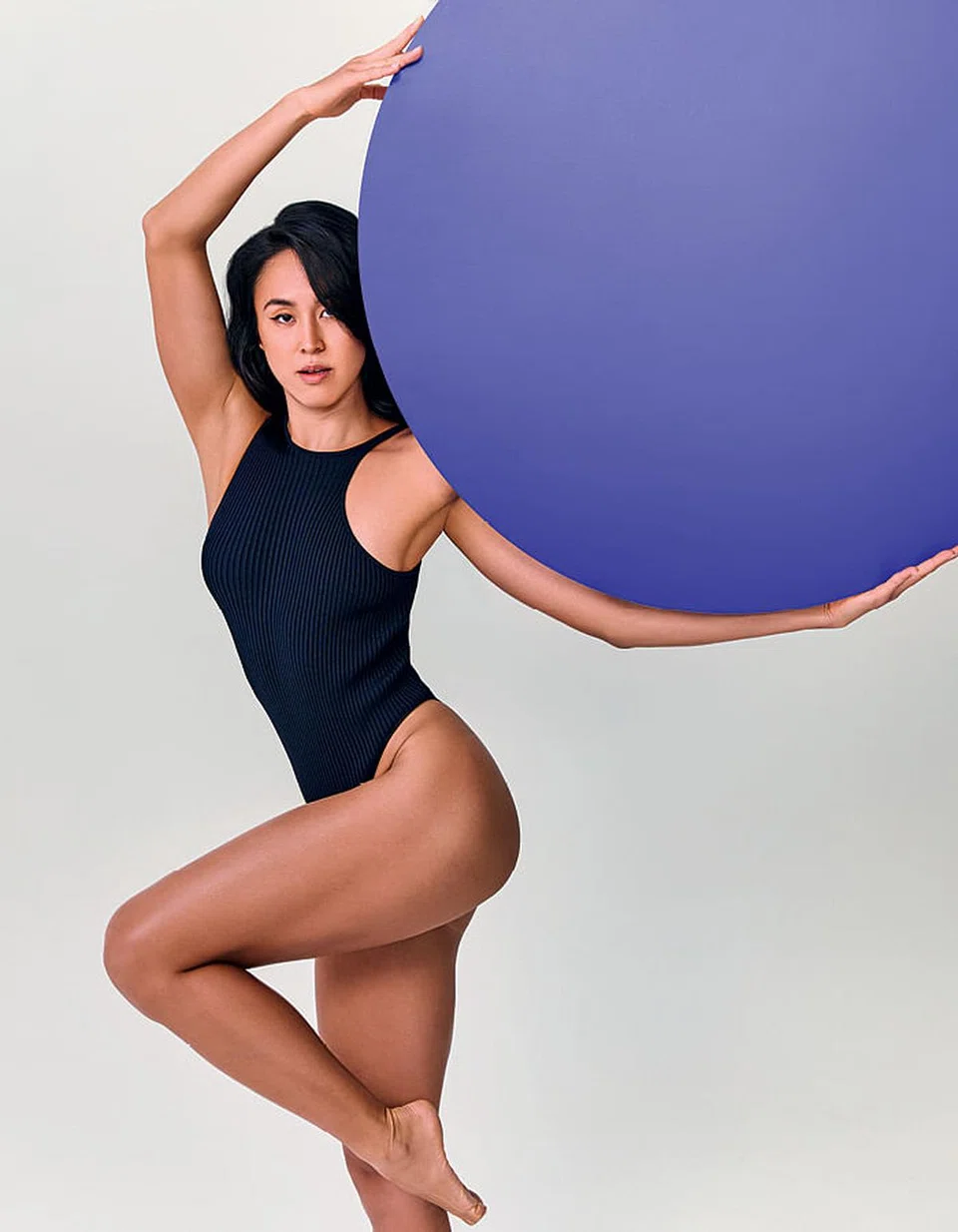
Bodysuit, Hermes
Right now, Ting Wen is focused entirely on the upcoming Games in Paris. This would be her fourth Olympics, having been to the Beijing, Rio and Tokyo editions previously.
“While the preparation and training is different [for each Games] because my body has changed over the last 15 years, my determination and mindset remain the same. The way I approach the training has not changed – I am focused, I understand what my goals are, and it’s a 100 per cent commitment from me.”
She is hoping to qualify for the individual swim events for the Olympics (the results are set to be announced this month). She also hopes for the relay team to make it to the top eight among the 16 teams. “To be the first relay team from Singapore to not just make it to the Olympics, but to the finals as well? That would be really special,” she shares.
Regardless of the outcome, Ting Wen’s confidence – both in the pool and on land – will guide her. “For me, confidence is about embracing my authentic self and being proud of who I am. It’s a mindset that I’ve cultivated over time through maturity, experience, and engaging with diverse individuals,” she asserts. “At some point, I'll step into the next chapter of my life. And I’ll just keep moving forward, because I know that everything has its own time and place.”
PHOTOGRAPHY DARREN GABRIEL LEOW
CREATIVE DIRECTION & STYLING LENA KAMARUDIN
ART DIRECTION RAY TICSAY
HAIR AUNG APICHAI
MAKEUP MELISSA YEO, USING DIOR
PHOTOGRAPHY ASSISTANT YANN CLOITRE
STYLING ASSISTANT SAW YONE YONE