%22%3E%3Cpath%20fill%3D%22%23000%22%20d%3D%22M79.702%2078.555c0%2033.03%2018.767%2046.361%2035.801%2046.361%2014.149%200%2029.738-7.033%2034.505-28.595l-1.445-.306c-3.61%2015.903-14.005%2027.371-33.06%2027.371-13.86%200-13.716-22.173-13.716-41.594V67.415h49.662c0-23.393-13.136-40.674-35.946-40.674-17.034%200-35.801%2018.94-35.801%2051.814m35.801-50.283c14.437%200%2014.005%2026.455%2013.861%2037.617h-27.573c-.004-18.353.865-37.617%2013.712-37.617%22%2F%3E%3C%2Fg%3E%3Cmask%20id%3D%22b%22%20width%3D%22603%22%20height%3D%22126%22%20x%3D%220%22%20y%3D%220%22%20maskUnits%3D%22userSpaceOnUse%22%20style%3D%22mask-type%3Aluminance%22%3E%3Cpath%20fill%3D%22%23fff%22%20d%3D%22M602.5%200H.5v125.074h602z%22%2F%3E%3C%2Fmask%3E%3Cg%20mask%3D%22url(%23b)%22%3E%3Cpath%20fill%3D%22%23000%22%20d%3D%22M86.81%20105.474h-1.445c0%2010.547-4.475%2011.463-5.483%2011.463-2.454%200-4.475-3.514-4.475-11.921V48.264c0-14.83-10.826-21.558-22.229-21.558-10.97%200-22.66%206.118-25.983%2017.276V8.478c-.515-4.763-4.26-8.48-8.893-8.48H.522v1.53H.5c2.886%200%204.763%201.988%204.763%205.045v110.211c0%203.057-1.877%205.045-4.763%205.045h.022v1.531h31.423v-1.531h.021c-2.885%200-4.762-1.988-4.762-5.045V50.252c0-10.395%208.949-18.806%2016.31-18.806%205.338%200%209.813%204.13%209.813%2014.83v58.74c0%2013.909%207.796%2019.874%2016.165%2019.874%209.958.005%2017.318-6.418%2017.318-19.416%22%2F%3E%3C%2Fg%3E%3Cmask%20id%3D%22c%22%20width%3D%22603%22%20height%3D%22126%22%20x%3D%220%22%20y%3D%220%22%20maskUnits%3D%22userSpaceOnUse%22%20style%3D%22mask-type%3Aluminance%22%3E%3Cpath%20fill%3D%22%23fff%22%20d%3D%22M602.5%200H.5v125.074h602z%22%2F%3E%3C%2Fmask%3E%3Cg%20mask%3D%22url(%23c)%22%3E%3Cpath%20fill%3D%22%23000%22%20d%3D%22M225.911%2042.197c0-10.552-11.259-16.818-22.954-16.818-10.682%200-21.513%205.045-25.119%2016.975v-7.352c-.48-4.574-3.977-8.148-8.364-8.398h-18.322v1.53h-.022c2.886%200%204.763%201.99%204.763%205.046v81.371h.004c.293%204.814%203.942%208.633%208.509%208.846v.004h18.173v-1.53h.022c-2.886%200-4.763-1.989-4.763-5.045V48.62c0-10.552%209.094-19.269%2016.602-19.269%204.763%200%208.805%203.672%209.386%2012.693%200%206.881%204.619%2011.773%2011.119%2011.773%206.631%200%2010.966-4.587%2010.966-11.62%22%2F%3E%3C%2Fg%3E%3Cmask%20id%3D%22d%22%20width%3D%22603%22%20height%3D%22126%22%20x%3D%220%22%20y%3D%220%22%20maskUnits%3D%22userSpaceOnUse%22%20style%3D%22mask-type%3Aluminance%22%3E%3Cpath%20fill%3D%22%23fff%22%20d%3D%22M602.5%200H.5v125.074h602z%22%2F%3E%3C%2Fmask%3E%3Cg%20mask%3D%22url(%23d)%22%3E%3Cpath%20fill%3D%22%23000%22%20d%3D%22M234.434%2028.315c2.925%200%205.583%202.312%206.779%205.863l29.782%2089.218h1.597l20.61-61.852%2020.609%2061.852h1.598l29.781-89.218c1.196-3.556%203.855-5.863%206.78-5.863h.183v-1.776h-11.538v1.776h.184c2.925%200%203.99%202.312%202.794%205.863l-18.082%2054.209-18.082-54.209c-1.196-3.556-.131-5.863%202.794-5.863h.183v-1.776h-33.343v1.776h.183c2.925%200%205.583%202.312%206.78%205.863l8.373%2025.058-9.705%2029.15-18.082-54.208c-1.196-3.556-.131-5.863%202.794-5.863h.184v-1.776h-33.344v1.776z%22%2F%3E%3C%2Fg%3E%3Cmask%20id%3D%22e%22%20width%3D%22603%22%20height%3D%22126%22%20x%3D%220%22%20y%3D%220%22%20maskUnits%3D%22userSpaceOnUse%22%20style%3D%22mask-type%3Aluminance%22%3E%3Cpath%20fill%3D%22%23fff%22%20d%3D%22M602.5%200H.5v125.074h602z%22%2F%3E%3C%2Fmask%3E%3Cg%20mask%3D%22url(%23e)%22%3E%3Cpath%20fill%3D%22%23000%22%20d%3D%22M377.826%20124.491c17.034%200%2038.211-15.699%2038.211-48.882%200-33.03-21.177-48.73-38.211-48.73-17.035%200-38.067%2015.857-38.067%2048.73.004%2033.026%2021.032%2048.882%2038.067%2048.882m0-96.085c13.86%200%2016.121%2028.24%2016.121%2047.356%200%2019.116-2.261%2047.198-16.121%2047.198-13.861%200-15.978-27.777-15.978-47.198%200-19.422%202.122-47.356%2015.978-47.356%22%2F%3E%3C%2Fg%3E%3Cmask%20id%3D%22f%22%20width%3D%22603%22%20height%3D%22126%22%20x%3D%220%22%20y%3D%220%22%20maskUnits%3D%22userSpaceOnUse%22%20style%3D%22mask-type%3Aluminance%22%3E%3Cpath%20fill%3D%22%23fff%22%20d%3D%22M602.5%200H.5v125.074h602z%22%2F%3E%3C%2Fmask%3E%3Cg%20mask%3D%22url(%23f)%22%3E%3Cpath%20fill%3D%22%23000%22%20d%3D%22M490.482%2042.197c0-10.552-11.258-16.818-22.953-16.818-10.683%200-21.513%205.045-25.119%2016.975v-7.352c-.48-4.574-3.977-8.148-8.365-8.398h-18.326v1.53h-.022c2.886%200%204.763%201.99%204.763%205.046v81.371h.004c.293%204.814%203.943%208.633%208.509%208.846v.004h18.173v-1.53h.022c-2.885%200-4.763-1.989-4.763-5.045V48.62c0-10.552%209.094-19.269%2016.602-19.269%204.763%200%208.806%203.672%209.386%2012.693%200%206.881%204.619%2011.773%2011.119%2011.773%206.64%200%2010.97-4.587%2010.97-11.62%22%2F%3E%3C%2Fg%3E%3Cmask%20id%3D%22g%22%20width%3D%22603%22%20height%3D%22126%22%20x%3D%220%22%20y%3D%220%22%20maskUnits%3D%22userSpaceOnUse%22%20style%3D%22mask-type%3Aluminance%22%3E%3Cpath%20fill%3D%22%23fff%22%20d%3D%22M602.5%200H.5v125.074h602z%22%2F%3E%3C%2Fmask%3E%3Cg%20mask%3D%22url(%23g)%22%3E%3Cpath%20fill%3D%22%23000%22%20d%3D%22M602.5%20103.974h-1.445c0%2010.553-4.474%2011.468-5.483%2011.468-2.453%200-4.474-3.519-4.474-11.925V6.585c0-3.056%201.877-5.045%204.762-5.045h-.166V.01h-17.715c-4.942%200-8.953%204.24-8.962%209.475h-.009v23.333c-6.063-3.977-9.84-5.503-16.48-5.503-17.034%200-35.801%2014.169-35.801%2047.046%200%2033.183%2013.101%2050.718%2035.801%2050.718%208.085%200%2013.302-2.294%2019.942-8.254%203.03%204.587%207.797%206.575%2012.704%206.575%209.966-.004%2017.326-6.427%2017.326-19.426m-30.75%2011.625c-4.763%204.435-10.84%205.822-13.38%205.822-11.482%200-19.558-16.933-19.558-46.907%200-29.97%2010.914-43.222%2019.885-43.222%203.3%200%206.264.153%2010.307%203.057v69.172c.004%205.04%201.017%209.017%202.746%2012.078%22%2F%3E%3C%2Fg%3E%3Cmask%20id%3D%22h%22%20width%3D%22603%22%20height%3D%22126%22%20x%3D%220%22%20y%3D%220%22%20maskUnits%3D%22userSpaceOnUse%22%20style%3D%22mask-type%3Aluminance%22%3E%3Cpath%20fill%3D%22%23fff%22%20d%3D%22M602.5%200H.5v125.074h602z%22%2F%3E%3C%2Fmask%3E%3Cg%20mask%3D%22url(%23h)%22%3E%3Cpath%20fill%3D%22%23000%22%20d%3D%22M516.984%20121.865c-2.885%200-4.763-1.988-4.763-5.045V9.466C512.2%204.241%20508.196.01%20503.259.01h-17.724v1.53h-.022c2.89%200%204.763%201.989%204.763%205.045v108.418c.515%204.564%204.029%208.129%208.434%208.337v.06h18.252v-1.53h.022z%22%2F%3E%3C%2Fg%3E%3C%2Fsvg%3E)
Can art give us a place to rest? Rajul Shah on painting, healing and why artists need community
Abstract artist Rajul Shah explores how art can create a sense of calm, and why she believes it can help people heal and bring communities together
By Cheryl Chan -
Share this article
Can art heal? That very question lies at the heart of Rajul Shah’s practice, shaping both the art she creates and the artistic communities she brings together.
Before she became a full-time artist and curator, the Mumbai-born, US-raised Shah spent around two decades working in healthcare marketing. Her work brought her close to the experiences of patients and caregivers dealing with chronic illness, pain and the emotional consequences that often accompany them.
“You learn clinically how a disease attacks the body and how the drugs work,” she says. “But it’s hard not to come away with an understanding of the emotional impact of having a disease, or of being a caregiver to someone who has one.”
It changed the way she thought about the relationship between our physical and emotional lives. When she eventually became a full-time artist, those questions followed her into the studio.
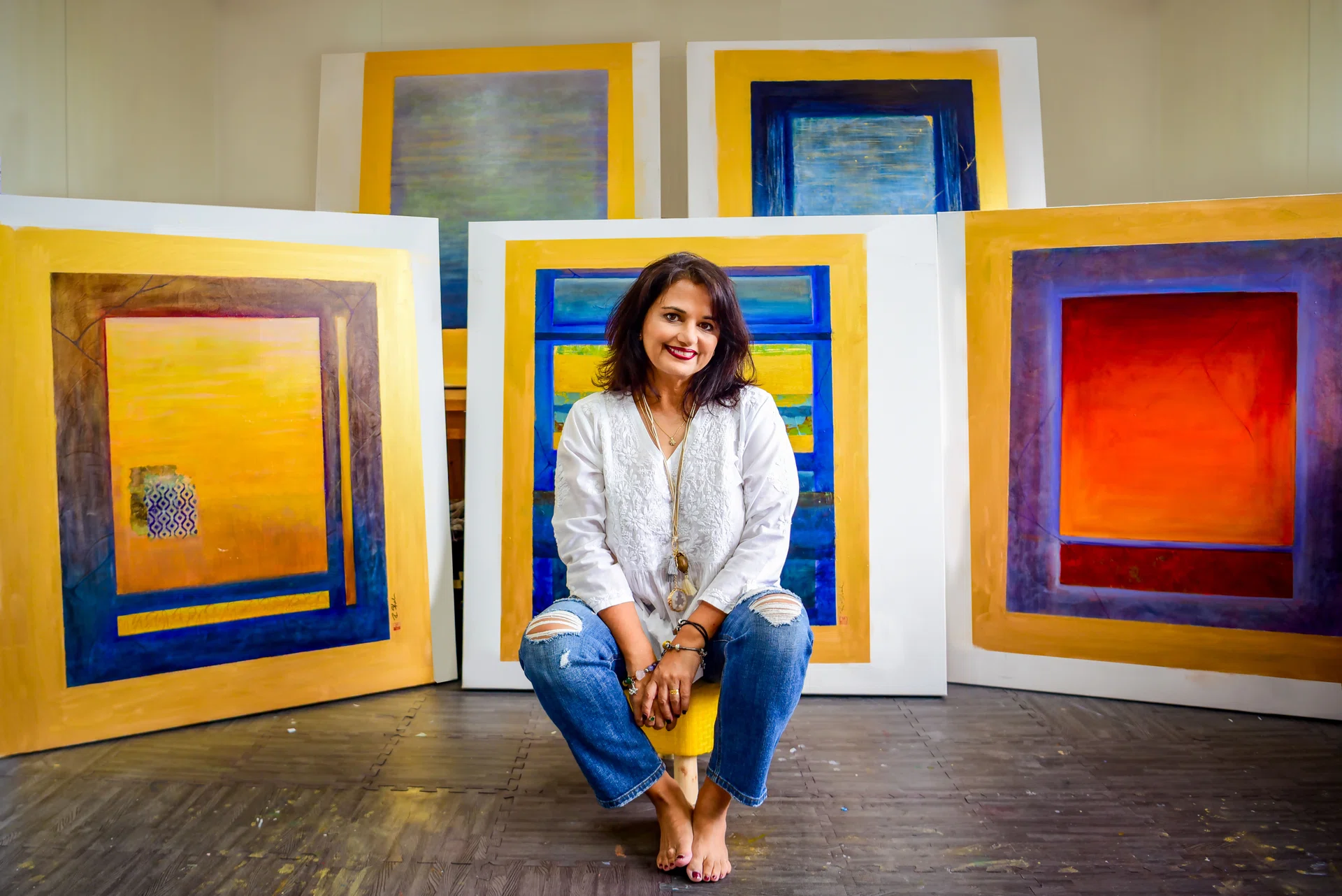
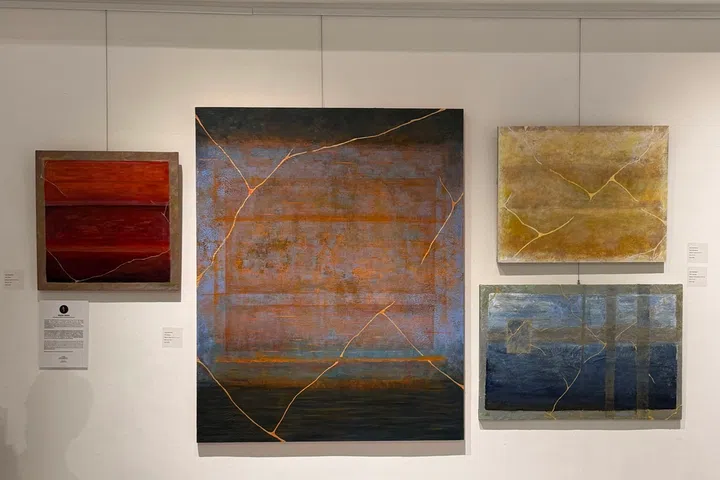
Today, Shah’s abstract paintings explore ideas of repair, balance and rest, drawing from traditions she encountered across very different parts of her life. Her Indian heritage appears through the chakra system, in which seven energy centres in the body are associated with different colours and qualities. Her years studying art in Japan introduced another influence: Kintsugi, the centuries-old practice of repairing broken ceramics with gold so that the cracks remain visible.
Shah isn’t interested in these traditions simply for their symbolism. They feed into a larger question in her work: how do you create something visually complex that nevertheless makes the person looking at it feel still?
“The purpose of my art is not to energise you. It is not to stimulate you. It is to give you a place to rest.”
That is harder than it sounds. Shah loves texture, which can have precisely the opposite effect. “I’m very tactile. I love using my hands and feeling texture,” she says. “But texture can be energising, right? When people see a lot of texture, it doesn’t necessarily calm them, it excites them. So the challenge I always pose to myself is: how do I make texture soothing?”
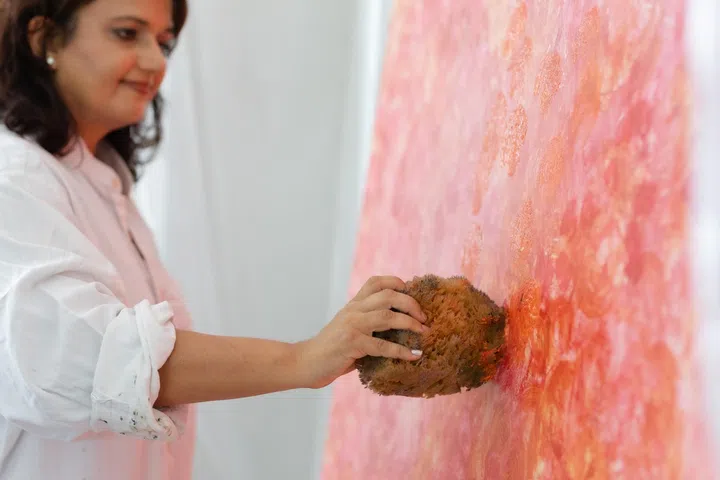
The first layers are often applied directly with her hands. She then gradually builds the surface through colour and glazing, sometimes creating as many as 20 translucent layers. She applies motifs, textured papers, and other elements, and then draws in the golden cracks—an element as visual as it is visceral.
“I want my paintings to glow,” she says. “If you go up close, you can see the layers of texture and sometimes the different layers of colour.”
The deception of abstract art and the need for community
Abstract art comes with its own peculiar misconception: that if there is no recognisable subject, there isn’t much technique involved. It’s easy to look at a canvas with no discernible landscape or figure and think: couldn’t I just splash colour onto a canvas too?
Shah argues that the apparent spontaneity is deceptive. “If you’re looking at a landscape and it’s a mountain, you know there’s the mountain. If it’s the sea, there’s the sea and the clouds. You can see what the focal point is,” she explains. “With abstract art, it’s harder.”
She describes one of the principles she learnt as “eye choreography”, deliberately constructing a painting to control where the viewer’s gaze enters, travels and eventually leaves the canvas.
“You have to place elements, whether that’s line, colour or texture, so that your eye follows a pattern: look at that corner, now go up there, now look over there, now bounce back into the painting.”
Her ambition? “My goal is that your eyes never exit my paintings.”
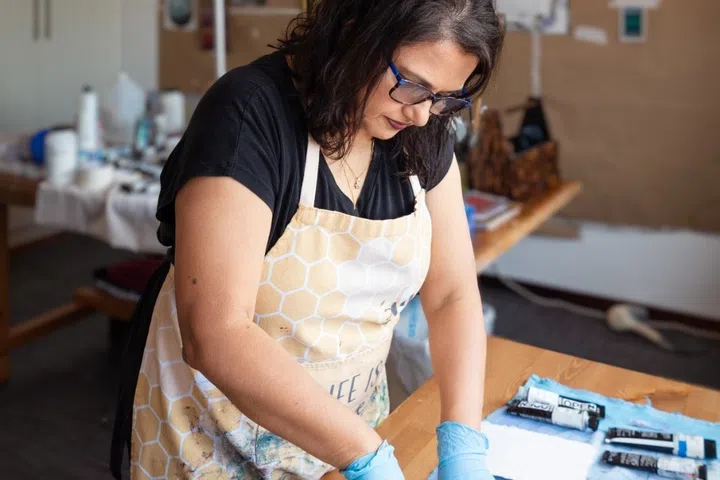
That discipline took years to develop. Shah spent seven years studying Nihonga in Japan under mother-and-daughter painters Shoko and Suiko Ohta, alongside further art studies in Tokyo, Singapore and the US.
Since then, her work has been shown in cities including New York, Tokyo, Osaka, Mumbai, Florence and Singapore, and has received recognition from the Artists Magazine Annual Art Competition, the Circle Foundation for the Arts and the Visual Artists Association in London.
But building a career as an artist also exposed her to something she hadn’t necessarily expected: how isolating the profession could be, even for an introvert. Her days working in a corporate office were full of discussions with colleagues, spontaneous lunches and dinners across several business trips. Art is different. As an artist, Rajul usually requires solitude when she creates; but she used to miss knocking on a fellow colleague’s door for a chat.
What happens when artists stop competing?
Rajul left her 20-year career in healthcare when she moved to Japan with her partner; there, she immersed herself in the world of art, learning and imbibing as much as she could. But building a career out of art at the age of 45 came with its own challenges.
Her first national juried acceptance to the 82nd Shinseisaku Exhibition helped establish her entrance in the industry. To further establish visibility and credibility, Shah and other professional women artists successfully started a small group, called W.A.A.T, Women Artists Association of Tokyo.
That positive experience eventually led Shah to start Canvas Connections in Singapore in 2023, bringing together women artists working across different styles and media.
For Shah, its value isn’t simply another opportunity to exhibit, it is what happens between exhibitions.
“I see us looking at each other’s work and looking at what the others do and how they show their work,” she says. “We’re feeding off each other and improving how we do our own things. We present our work to each other for constructive feedback. We’ve arranged master classes, opened up our studios to one another to share different techniques and helped each other in our businesses; we once had a workshop on how to make the best Instagram Reels, for example.”
She is candid about why she values that environment. There is always a place for healthy and constructive competition, but she agrees that the art industry in Singapore can be challenging. “There are a lot of competitive artists, and I don’t think competition in art is healthy for the greater whole,” she says. “It suggests that my art is the same as yours, when it’s not. It suggests that a person who buys your art would easily trade it for mine, and that’s not the case.” Unhealthy competition creates dynamics, Shah believes, that discourage overall growth of the community.
Canvas Connections, she says, gives something different. “It’s a safe space. We’re supportive of each other and always looking out for opportunities that one or more of us can benefit from.”
That philosophy has ended up shaping the collective itself. Its fifth exhibition in four years “The Gathering Line”, brought together 11 women artists whose work is deliberately very different.
The title borrows from cartography, where a gathering line describes the point at which landforms draw close. For Canvas Connections, it has become a metaphor for what Shah and Aparna Chakravarty (another founding member) are trying to create: artists whose practices can sit beside one another without competing for the same space.
Among the exhibiting artists were Susan Olij, who was shortlisted for UOB Painting of the Year in 2025; Margarita Buttenmueller, shortlisted in 2025 and 2026; Irina Forrester, a finalist for the Art Gemini Prize; Berenika Drazewska, a member of the Singapore Watercolour Society; and Shah herself. In total, about 13 artworks were sold that weekend.
Shah herself exhibited artworks from her Kintsugi Chakra series. Her newest works “Viridian on Indigo” and “Kintsugi Elements V include mixed media elements of Washi Paper, collage, pastel, pencil, metal leaf and acrylic. She also unveiled her very first ceramic sculptures that align with the same intent as her two-dimensional work. “Sentinel I” and “Sanctuary I” speak directly to the protection and respite of personal energy flows to strengthen one’s ability to be resilient.
Shah is currently represented by Vedica Art Studios & Gallery, Mumbai, India. You can also find her on Instagram at @Rajul_Shah_Art and @vessels.of.stillness and on her website.