%22%3E%3Cpath%20fill%3D%22%23000%22%20d%3D%22M79.702%2078.555c0%2033.03%2018.767%2046.361%2035.801%2046.361%2014.149%200%2029.738-7.033%2034.505-28.595l-1.445-.306c-3.61%2015.903-14.005%2027.371-33.06%2027.371-13.86%200-13.716-22.173-13.716-41.594V67.415h49.662c0-23.393-13.136-40.674-35.946-40.674-17.034%200-35.801%2018.94-35.801%2051.814m35.801-50.283c14.437%200%2014.005%2026.455%2013.861%2037.617h-27.573c-.004-18.353.865-37.617%2013.712-37.617%22%2F%3E%3C%2Fg%3E%3Cmask%20id%3D%22b%22%20width%3D%22603%22%20height%3D%22126%22%20x%3D%220%22%20y%3D%220%22%20maskUnits%3D%22userSpaceOnUse%22%20style%3D%22mask-type%3Aluminance%22%3E%3Cpath%20fill%3D%22%23fff%22%20d%3D%22M602.5%200H.5v125.074h602z%22%2F%3E%3C%2Fmask%3E%3Cg%20mask%3D%22url(%23b)%22%3E%3Cpath%20fill%3D%22%23000%22%20d%3D%22M86.81%20105.474h-1.445c0%2010.547-4.475%2011.463-5.483%2011.463-2.454%200-4.475-3.514-4.475-11.921V48.264c0-14.83-10.826-21.558-22.229-21.558-10.97%200-22.66%206.118-25.983%2017.276V8.478c-.515-4.763-4.26-8.48-8.893-8.48H.522v1.53H.5c2.886%200%204.763%201.988%204.763%205.045v110.211c0%203.057-1.877%205.045-4.763%205.045h.022v1.531h31.423v-1.531h.021c-2.885%200-4.762-1.988-4.762-5.045V50.252c0-10.395%208.949-18.806%2016.31-18.806%205.338%200%209.813%204.13%209.813%2014.83v58.74c0%2013.909%207.796%2019.874%2016.165%2019.874%209.958.005%2017.318-6.418%2017.318-19.416%22%2F%3E%3C%2Fg%3E%3Cmask%20id%3D%22c%22%20width%3D%22603%22%20height%3D%22126%22%20x%3D%220%22%20y%3D%220%22%20maskUnits%3D%22userSpaceOnUse%22%20style%3D%22mask-type%3Aluminance%22%3E%3Cpath%20fill%3D%22%23fff%22%20d%3D%22M602.5%200H.5v125.074h602z%22%2F%3E%3C%2Fmask%3E%3Cg%20mask%3D%22url(%23c)%22%3E%3Cpath%20fill%3D%22%23000%22%20d%3D%22M225.911%2042.197c0-10.552-11.259-16.818-22.954-16.818-10.682%200-21.513%205.045-25.119%2016.975v-7.352c-.48-4.574-3.977-8.148-8.364-8.398h-18.322v1.53h-.022c2.886%200%204.763%201.99%204.763%205.046v81.371h.004c.293%204.814%203.942%208.633%208.509%208.846v.004h18.173v-1.53h.022c-2.886%200-4.763-1.989-4.763-5.045V48.62c0-10.552%209.094-19.269%2016.602-19.269%204.763%200%208.805%203.672%209.386%2012.693%200%206.881%204.619%2011.773%2011.119%2011.773%206.631%200%2010.966-4.587%2010.966-11.62%22%2F%3E%3C%2Fg%3E%3Cmask%20id%3D%22d%22%20width%3D%22603%22%20height%3D%22126%22%20x%3D%220%22%20y%3D%220%22%20maskUnits%3D%22userSpaceOnUse%22%20style%3D%22mask-type%3Aluminance%22%3E%3Cpath%20fill%3D%22%23fff%22%20d%3D%22M602.5%200H.5v125.074h602z%22%2F%3E%3C%2Fmask%3E%3Cg%20mask%3D%22url(%23d)%22%3E%3Cpath%20fill%3D%22%23000%22%20d%3D%22M234.434%2028.315c2.925%200%205.583%202.312%206.779%205.863l29.782%2089.218h1.597l20.61-61.852%2020.609%2061.852h1.598l29.781-89.218c1.196-3.556%203.855-5.863%206.78-5.863h.183v-1.776h-11.538v1.776h.184c2.925%200%203.99%202.312%202.794%205.863l-18.082%2054.209-18.082-54.209c-1.196-3.556-.131-5.863%202.794-5.863h.183v-1.776h-33.343v1.776h.183c2.925%200%205.583%202.312%206.78%205.863l8.373%2025.058-9.705%2029.15-18.082-54.208c-1.196-3.556-.131-5.863%202.794-5.863h.184v-1.776h-33.344v1.776z%22%2F%3E%3C%2Fg%3E%3Cmask%20id%3D%22e%22%20width%3D%22603%22%20height%3D%22126%22%20x%3D%220%22%20y%3D%220%22%20maskUnits%3D%22userSpaceOnUse%22%20style%3D%22mask-type%3Aluminance%22%3E%3Cpath%20fill%3D%22%23fff%22%20d%3D%22M602.5%200H.5v125.074h602z%22%2F%3E%3C%2Fmask%3E%3Cg%20mask%3D%22url(%23e)%22%3E%3Cpath%20fill%3D%22%23000%22%20d%3D%22M377.826%20124.491c17.034%200%2038.211-15.699%2038.211-48.882%200-33.03-21.177-48.73-38.211-48.73-17.035%200-38.067%2015.857-38.067%2048.73.004%2033.026%2021.032%2048.882%2038.067%2048.882m0-96.085c13.86%200%2016.121%2028.24%2016.121%2047.356%200%2019.116-2.261%2047.198-16.121%2047.198-13.861%200-15.978-27.777-15.978-47.198%200-19.422%202.122-47.356%2015.978-47.356%22%2F%3E%3C%2Fg%3E%3Cmask%20id%3D%22f%22%20width%3D%22603%22%20height%3D%22126%22%20x%3D%220%22%20y%3D%220%22%20maskUnits%3D%22userSpaceOnUse%22%20style%3D%22mask-type%3Aluminance%22%3E%3Cpath%20fill%3D%22%23fff%22%20d%3D%22M602.5%200H.5v125.074h602z%22%2F%3E%3C%2Fmask%3E%3Cg%20mask%3D%22url(%23f)%22%3E%3Cpath%20fill%3D%22%23000%22%20d%3D%22M490.482%2042.197c0-10.552-11.258-16.818-22.953-16.818-10.683%200-21.513%205.045-25.119%2016.975v-7.352c-.48-4.574-3.977-8.148-8.365-8.398h-18.326v1.53h-.022c2.886%200%204.763%201.99%204.763%205.046v81.371h.004c.293%204.814%203.943%208.633%208.509%208.846v.004h18.173v-1.53h.022c-2.885%200-4.763-1.989-4.763-5.045V48.62c0-10.552%209.094-19.269%2016.602-19.269%204.763%200%208.806%203.672%209.386%2012.693%200%206.881%204.619%2011.773%2011.119%2011.773%206.64%200%2010.97-4.587%2010.97-11.62%22%2F%3E%3C%2Fg%3E%3Cmask%20id%3D%22g%22%20width%3D%22603%22%20height%3D%22126%22%20x%3D%220%22%20y%3D%220%22%20maskUnits%3D%22userSpaceOnUse%22%20style%3D%22mask-type%3Aluminance%22%3E%3Cpath%20fill%3D%22%23fff%22%20d%3D%22M602.5%200H.5v125.074h602z%22%2F%3E%3C%2Fmask%3E%3Cg%20mask%3D%22url(%23g)%22%3E%3Cpath%20fill%3D%22%23000%22%20d%3D%22M602.5%20103.974h-1.445c0%2010.553-4.474%2011.468-5.483%2011.468-2.453%200-4.474-3.519-4.474-11.925V6.585c0-3.056%201.877-5.045%204.762-5.045h-.166V.01h-17.715c-4.942%200-8.953%204.24-8.962%209.475h-.009v23.333c-6.063-3.977-9.84-5.503-16.48-5.503-17.034%200-35.801%2014.169-35.801%2047.046%200%2033.183%2013.101%2050.718%2035.801%2050.718%208.085%200%2013.302-2.294%2019.942-8.254%203.03%204.587%207.797%206.575%2012.704%206.575%209.966-.004%2017.326-6.427%2017.326-19.426m-30.75%2011.625c-4.763%204.435-10.84%205.822-13.38%205.822-11.482%200-19.558-16.933-19.558-46.907%200-29.97%2010.914-43.222%2019.885-43.222%203.3%200%206.264.153%2010.307%203.057v69.172c.004%205.04%201.017%209.017%202.746%2012.078%22%2F%3E%3C%2Fg%3E%3Cmask%20id%3D%22h%22%20width%3D%22603%22%20height%3D%22126%22%20x%3D%220%22%20y%3D%220%22%20maskUnits%3D%22userSpaceOnUse%22%20style%3D%22mask-type%3Aluminance%22%3E%3Cpath%20fill%3D%22%23fff%22%20d%3D%22M602.5%200H.5v125.074h602z%22%2F%3E%3C%2Fmask%3E%3Cg%20mask%3D%22url(%23h)%22%3E%3Cpath%20fill%3D%22%23000%22%20d%3D%22M516.984%20121.865c-2.885%200-4.763-1.988-4.763-5.045V9.466C512.2%204.241%20508.196.01%20503.259.01h-17.724v1.53h-.022c2.89%200%204.763%201.989%204.763%205.045v108.418c.515%204.564%204.029%208.129%208.434%208.337v.06h18.252v-1.53h.022z%22%2F%3E%3C%2Fg%3E%3C%2Fsvg%3E)
Banyan Group’s Claire Chiang taps into the kampung spirit for her next chapter
Claire Chiang has always believed in the power of diversity and listening deeply. The Banyan Group co-founder shares how a commitment to community has shaped the way she lives and leads
By Chelsia Tan -
Share this article
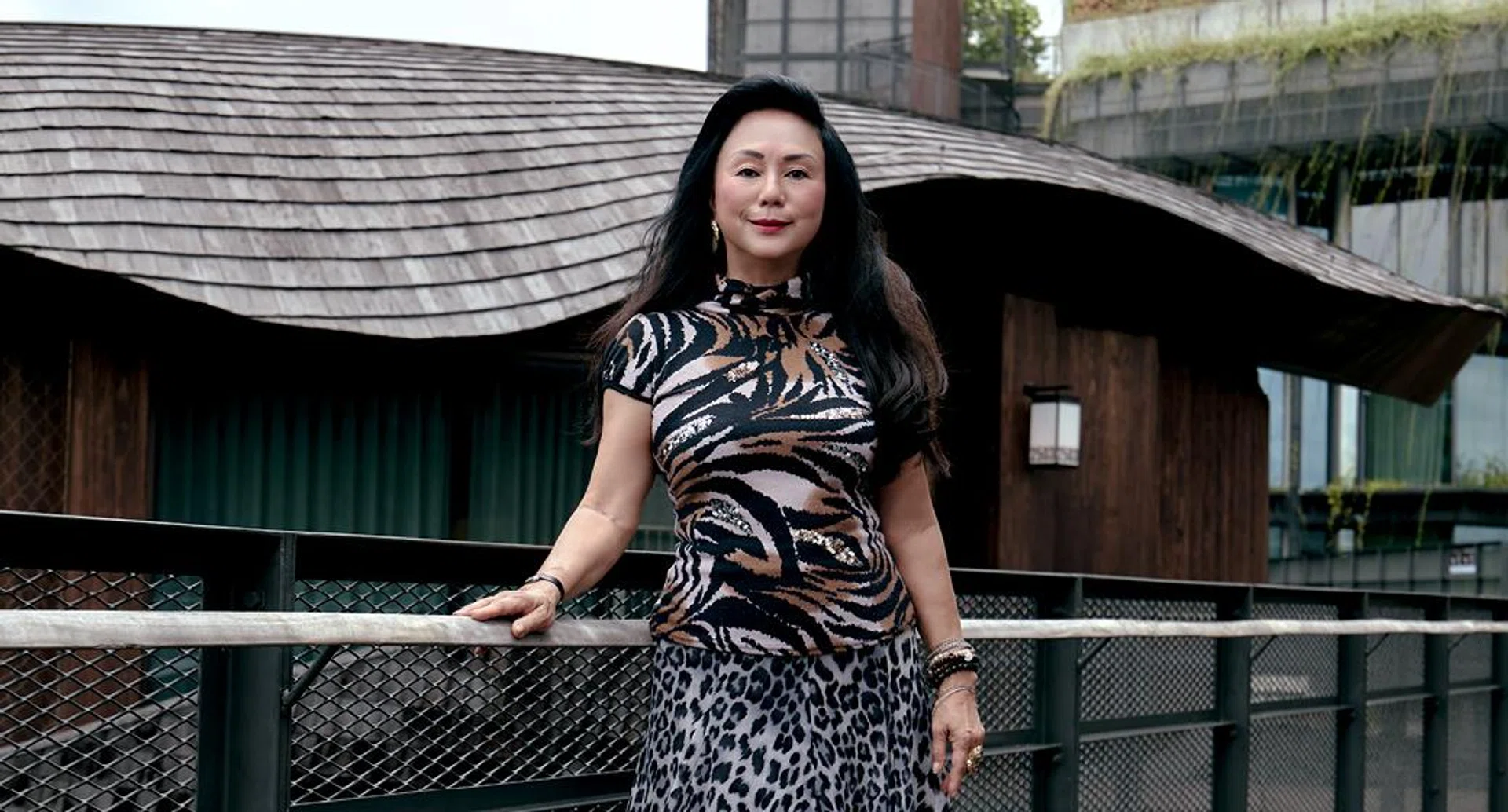
A few years ago, Claire Chiang was dining at a French restaurant in Phuket when a man in his 30s approached her. With a glass of wine in hand, he raised a toast to the co-founder of Banyan Group, leaving her momentarily puzzled.
“Who are you?” she asked.
Recounting the encounter to Her World, Claire recalls that the man simply thanked her before explaining that he was from the first graduating batch of the kindergarten she had started decades earlier.
“He was about 34 then, with two children – and now he’s a mixologist,” she adds. ‘
The man had been a pupil at Laguna Phuket Kindergarten, which Claire founded in 1992 to provide to provide free childcare services and preschool education to children of community members and associates.
The 74-year-old is well known for co-founding Banyan Group and Banyan Tree Gallery – the retail extension of Banyan Tree Hotels & Resorts – with her husband, Ho Kwon Ping, in 1994.
Their daughter, the second of three children, Ho Ren Yung, serves as deputy CEO and senior vicepresident of Brand HQ.
Today, the group has a presence in more than 20 countries, with over 140 spas and galleries, more than 20 branded residences, and 100 hotels and resorts worldwide. Last year, it marked a milestone with the official launch of its 100th global resort, Mandai Rainforest Resort by Banyan Tree.
Laguna Phuket Kindergarten has since evolved into Silk: Step-Up International Laguna Kindergarten, a fully fledged institution serving children of diverse nationalities.
Recognised as one of Thailand’s leading early learning schools, it follows a curriculum inspired by Singapore’s Nurturing Early Learners Framework, with a strong emphasis on experiential learning.
Ask her about Silk and she lights up. “Thirty years ago, we started a Thai kindergarten for our women associates, to help them better balance work and family life. We’ve had more than 100 children every year for the past three decades,” she says.
As Phuket’s population grew and the community became increasingly international, Claire saw the need for an English-language kindergarten to support children in developing stronger language skills.
“That’s why I started Silk,” she explains. “And why ‘silk’? Because silk is a very soft but strong fibre – and it connects East and West. I had two retired Singaporean teachers help set up the core curriculum. Since April 2023, it has really taken off.”
Embracing diversity as social capital
Creating diversity has always mattered to Claire. It inspired her to establish Banyan Tree Gallery – a space showcasing curated pieces sourced through an international network of village cooperatives, creating meaningful work for artisans in the communities where their resorts are based, while preserving local culture and heritage.
The inspiration emerged from a conversation with Singapore women’s rights activist Shirin Fozdar, who had once asked Claire to buy cushions, with the proceeds going towards supporting a girl’s education.
Recalling the moment in a 2015 interview with The Economic Times, Claire said: “I thought maybe I could buy 2,000 cushions and help a village. It was that power – and the possibility of giving girls a chance to learn – that made me decide to leave academia and, together with my husband, establish Banyan Tree and Banyan Tree Gallery.”
That same ethos doesn’t stop at how she runs her business. In 2009, she set up the Banyan Tree Global Foundation, through which Banyan Group supports community-based initiatives in the places where it operates.
When asked about the range of Banyan’s properties – from Africa to Latin America – Claire points to the company’s corporate culture, which emphasises the environment, community, self-care, health and well-being.
“Diversity is the social capital we work with, and that mindset informs how we govern, operate and deliver. It’s not just the Singapore way – it’s the Banyan way,” she says matter-of-factly.
It is also very much Claire’s own way – how she seeks out interesting art and craft pieces from her travels. Once, in Lijiang, China, she went to a shop in search of Naxi (an ethnic group living in Lijiang) woodcraft. Like her encounter at the French restaurant, the shopkeeper recognised her immediately.
“I first met Ah Dong 20 years ago, when I bought my very first wooden piece from him,” Claire recalls. “He recognised me straight away and said, ‘You are the Hainanese owner from Singapore, Banyan Group.’ He told me he’s the last remaining craftsman – everything else has become too commercial.”
Over the past two decades, Ah Dong, whose given name is He Jinping, has become a leading figure in modern Naxi woodcarving. His works have been exhibited internationally and collected by institutions including Unesco.
Recognised as a Representative Inheritor of Lijiang Wood Carving, a National Intangible Cultural Heritage, he has also been named a Yunnan Master Craftsman and Provincial Master of Arts and Crafts
Pointing to the stack of thin silver bangles on her arm, she adds: “All my silver pieces are from that same trip to Lijiang. The craftsmanship is over 120 years old – you can’t find this quality anymore.”
Claire continues to stock his pieces in Banyan Tree Gallery boutiques, but exporting wooden works has become increasingly difficult, complicated by customs regulations, communication barriers and rising costs.
“So now we focus on localisation and indigenisation,” she says. “Supporting local craft, going local – that’s what we believe in.”
The importance of “Gotong Royong”
Claire’s passion for localisation goes back to her childhood – she grew up in a crowded shophouse in Race Course Road with her parents and five older brothers. Around her were neighbours from all races and backgrounds that made up Singapore’s rich multi-cultural fabric.
Difference was simply part of everyday life. “My ‘uncles’ were Indian, my neighbours across the road were Malay, and my school friends were Chinese. I had a barber, a grocer uncle, a coffee shop uncle – all from different races. I literally grew up in what I see as Singapore’s social capital,” she recalls.
That early exposure continues to influence how she sees herself today. “I don’t see myself as just ‘Claire from Singapore’. It’s this mix of influences – Malay, Indian, Chinese – that has shaped me. That blending and mixing is very much a part of who I am.”
It felt only natural, then, that this sense of “rojak” – a mishmash of cultures – would lead her to study sociology, first at the University of Singapore in the 1970s, before continuing her studies at Sorbonne University in Paris, and later completing a master’s degree in sociology at the University of Hong Kong in 1985.
Life before Banyan Group was one of academia. After returning from Hong Kong with her husband in the early 1990s, she worked as a research sociologist at the National University of Singapore.
She later co-wrote Stepping Out – The Making of Chinese Entrepreneurs, which was adapted into a popular Mediacorp TV series about the lives of early Chinese immigrants in Singapore.
“I grew up understanding the importance of community – gotong royong – the traditionally Indonesian and Malay concept of gratitude and reciprocity,” says Claire, a lesson ingrained in her when her mother had a stroke in 1970.
Neighbours brought food and stepped in to help with daily needs. When the family had to move from one place to another, it was the community that supported them.
This same sense of community later inspired Claire Chiang to help set up the helpline and call centre for Association of Women for Action and Research (Aware) in 1990, renting out her former shophouse home to support the non-profit’s work. She was elected Aware’s president in 1993, before taking on the role of president of the Society Against Family Violence two years later.
From 1997 to 2001, Claire served as a Nominated Member of Parliament, where she focused on issues close to her heart – from compulsory education and protections for children to parental consent laws and the rights of domestic helpers.
How loss shaped the way she leads
This chapter of her life, however, began with loss. “The turning point for me was losing a child,” says Claire. “I lost a baby during my third pregnancy. It changed my thinking – from ‘Why me?’ to ‘Why not me?’”
She fell into depression. “I already had two children, and people kept saying, ‘It’s just a miscarriage.’ But grief is deeply personal.”
Claire withdrew from the world around her. She avoided conversation, choosing instead to immerse herself in learning by studying sign language at a deaf school and training as a Samaritan. For four years, she worked night shifts from 8pm to 8am. It was during those long, quiet hours that she came to understand the power of active listening.
“I worked with victims of violence and families in crisis,” recalls Claire. “I went on to start inperson counselling and support groups, as well as programmes for men. I also worked closely with the police, training seven land divisions on rape crisis response for more than a decade.”
Through all of it, she came to understand how society and the individual are closely connected – what, she says, sociology is really about.
“We carry society within us, but we also resist and redefine it,” Claire reflects. “That tension creates complexity, and the work is learning how to hold that complexity without judgment.
That way of thinking guides the Banyan Group, where a culture of diversity is intentional. “We talk about gender, shared responsibility, and what it means to be human – not just male or female,” she says.
Claire explains that she sees masculine and feminine qualities not as fixed traits, but as skill sets that can be drawn on as needed. Context, she believes, matters, as different situations call for different qualities.
“Allyship happens when we drop labels and focus on the problem at hand,” she continues. “It requires 360-degree thinking – not just addressing what’s obvious, but also the unseen factors. Leadership, ultimately, is about having the courage to decide. Managers manage, but leaders decide and lead.
Becoming, again and again
Looking back, and ahead, Claire reflects on her life as “the becoming of many parts”. Life, she believes, is not simply the sum of its parts, but an ongoing process of becoming – of growing more whole, over time.
From a young age, she learnt to be independent. Her parents did not interfere in her choices. Not because they were indifferent, she says, but because they lacked the means to guide her on where to study or what discipline to pursue.
Many of her requests, such as joining the Girl Guides or studying abroad, were met with a firm no, and over time, she learnt to chart her own path.
“I could have felt deprived, but instead I learnt to find other ways. I loved sports, dance and craft. I gathered the resources around me – my grandmother, my friends – and recomposed my life with what I had,” she says.
“After 21, I was on my own. I gave tuition to earn money. I cut my first haircut for $25. I became an entrepreneur early on.”
That independence, Claire says, shaped not just who she is, but how she imagines what comes next, shifting from carving her own path to building something shared.
“Right now, what excites me most is building a platform that gathers like-minded people to create one Banyan village, a village grounded in responsibility, collaboration, global values, love, family and community,” she says.
As part of this vision, she is curating a series of “Lifecations” retreats, designed to uncover the quieter, often overlooked soul of a city. Each edition brings together nature, community and well-being, inviting participants to engage more deeply with local culture, while embracing sustainable living.
Building on earlier gatherings in Lijiang and Bangkok, future editions may turn to cities such as Shanghai, with further details to be announced later this year.
“I think capitalism has robbed many of us of self-agency. We need to rediscover that inner strength to define and compose our lives. Every two years, I feel like I recompose mine,” she muses.
She pauses, then adds: “Every time a door closes, another opens. If you don’t shut yourself off, there’s always somewhere to go.”
PHOTOGRAPHY Angela Guo, assisted by Intan Naturelle Adam-Mccallum
ART DIRECTION Adeline Eng
COORDINATION Chelsia Tan
LOCATION Mandai Rainforest Resort By Banyan Tree