%22%3E%3Cpath%20fill%3D%22%23000%22%20d%3D%22M79.702%2078.555c0%2033.03%2018.767%2046.361%2035.801%2046.361%2014.149%200%2029.738-7.033%2034.505-28.595l-1.445-.306c-3.61%2015.903-14.005%2027.371-33.06%2027.371-13.86%200-13.716-22.173-13.716-41.594V67.415h49.662c0-23.393-13.136-40.674-35.946-40.674-17.034%200-35.801%2018.94-35.801%2051.814m35.801-50.283c14.437%200%2014.005%2026.455%2013.861%2037.617h-27.573c-.004-18.353.865-37.617%2013.712-37.617%22%2F%3E%3C%2Fg%3E%3Cmask%20id%3D%22b%22%20width%3D%22603%22%20height%3D%22126%22%20x%3D%220%22%20y%3D%220%22%20maskUnits%3D%22userSpaceOnUse%22%20style%3D%22mask-type%3Aluminance%22%3E%3Cpath%20fill%3D%22%23fff%22%20d%3D%22M602.5%200H.5v125.074h602z%22%2F%3E%3C%2Fmask%3E%3Cg%20mask%3D%22url(%23b)%22%3E%3Cpath%20fill%3D%22%23000%22%20d%3D%22M86.81%20105.474h-1.445c0%2010.547-4.475%2011.463-5.483%2011.463-2.454%200-4.475-3.514-4.475-11.921V48.264c0-14.83-10.826-21.558-22.229-21.558-10.97%200-22.66%206.118-25.983%2017.276V8.478c-.515-4.763-4.26-8.48-8.893-8.48H.522v1.53H.5c2.886%200%204.763%201.988%204.763%205.045v110.211c0%203.057-1.877%205.045-4.763%205.045h.022v1.531h31.423v-1.531h.021c-2.885%200-4.762-1.988-4.762-5.045V50.252c0-10.395%208.949-18.806%2016.31-18.806%205.338%200%209.813%204.13%209.813%2014.83v58.74c0%2013.909%207.796%2019.874%2016.165%2019.874%209.958.005%2017.318-6.418%2017.318-19.416%22%2F%3E%3C%2Fg%3E%3Cmask%20id%3D%22c%22%20width%3D%22603%22%20height%3D%22126%22%20x%3D%220%22%20y%3D%220%22%20maskUnits%3D%22userSpaceOnUse%22%20style%3D%22mask-type%3Aluminance%22%3E%3Cpath%20fill%3D%22%23fff%22%20d%3D%22M602.5%200H.5v125.074h602z%22%2F%3E%3C%2Fmask%3E%3Cg%20mask%3D%22url(%23c)%22%3E%3Cpath%20fill%3D%22%23000%22%20d%3D%22M225.911%2042.197c0-10.552-11.259-16.818-22.954-16.818-10.682%200-21.513%205.045-25.119%2016.975v-7.352c-.48-4.574-3.977-8.148-8.364-8.398h-18.322v1.53h-.022c2.886%200%204.763%201.99%204.763%205.046v81.371h.004c.293%204.814%203.942%208.633%208.509%208.846v.004h18.173v-1.53h.022c-2.886%200-4.763-1.989-4.763-5.045V48.62c0-10.552%209.094-19.269%2016.602-19.269%204.763%200%208.805%203.672%209.386%2012.693%200%206.881%204.619%2011.773%2011.119%2011.773%206.631%200%2010.966-4.587%2010.966-11.62%22%2F%3E%3C%2Fg%3E%3Cmask%20id%3D%22d%22%20width%3D%22603%22%20height%3D%22126%22%20x%3D%220%22%20y%3D%220%22%20maskUnits%3D%22userSpaceOnUse%22%20style%3D%22mask-type%3Aluminance%22%3E%3Cpath%20fill%3D%22%23fff%22%20d%3D%22M602.5%200H.5v125.074h602z%22%2F%3E%3C%2Fmask%3E%3Cg%20mask%3D%22url(%23d)%22%3E%3Cpath%20fill%3D%22%23000%22%20d%3D%22M234.434%2028.315c2.925%200%205.583%202.312%206.779%205.863l29.782%2089.218h1.597l20.61-61.852%2020.609%2061.852h1.598l29.781-89.218c1.196-3.556%203.855-5.863%206.78-5.863h.183v-1.776h-11.538v1.776h.184c2.925%200%203.99%202.312%202.794%205.863l-18.082%2054.209-18.082-54.209c-1.196-3.556-.131-5.863%202.794-5.863h.183v-1.776h-33.343v1.776h.183c2.925%200%205.583%202.312%206.78%205.863l8.373%2025.058-9.705%2029.15-18.082-54.208c-1.196-3.556-.131-5.863%202.794-5.863h.184v-1.776h-33.344v1.776z%22%2F%3E%3C%2Fg%3E%3Cmask%20id%3D%22e%22%20width%3D%22603%22%20height%3D%22126%22%20x%3D%220%22%20y%3D%220%22%20maskUnits%3D%22userSpaceOnUse%22%20style%3D%22mask-type%3Aluminance%22%3E%3Cpath%20fill%3D%22%23fff%22%20d%3D%22M602.5%200H.5v125.074h602z%22%2F%3E%3C%2Fmask%3E%3Cg%20mask%3D%22url(%23e)%22%3E%3Cpath%20fill%3D%22%23000%22%20d%3D%22M377.826%20124.491c17.034%200%2038.211-15.699%2038.211-48.882%200-33.03-21.177-48.73-38.211-48.73-17.035%200-38.067%2015.857-38.067%2048.73.004%2033.026%2021.032%2048.882%2038.067%2048.882m0-96.085c13.86%200%2016.121%2028.24%2016.121%2047.356%200%2019.116-2.261%2047.198-16.121%2047.198-13.861%200-15.978-27.777-15.978-47.198%200-19.422%202.122-47.356%2015.978-47.356%22%2F%3E%3C%2Fg%3E%3Cmask%20id%3D%22f%22%20width%3D%22603%22%20height%3D%22126%22%20x%3D%220%22%20y%3D%220%22%20maskUnits%3D%22userSpaceOnUse%22%20style%3D%22mask-type%3Aluminance%22%3E%3Cpath%20fill%3D%22%23fff%22%20d%3D%22M602.5%200H.5v125.074h602z%22%2F%3E%3C%2Fmask%3E%3Cg%20mask%3D%22url(%23f)%22%3E%3Cpath%20fill%3D%22%23000%22%20d%3D%22M490.482%2042.197c0-10.552-11.258-16.818-22.953-16.818-10.683%200-21.513%205.045-25.119%2016.975v-7.352c-.48-4.574-3.977-8.148-8.365-8.398h-18.326v1.53h-.022c2.886%200%204.763%201.99%204.763%205.046v81.371h.004c.293%204.814%203.943%208.633%208.509%208.846v.004h18.173v-1.53h.022c-2.885%200-4.763-1.989-4.763-5.045V48.62c0-10.552%209.094-19.269%2016.602-19.269%204.763%200%208.806%203.672%209.386%2012.693%200%206.881%204.619%2011.773%2011.119%2011.773%206.64%200%2010.97-4.587%2010.97-11.62%22%2F%3E%3C%2Fg%3E%3Cmask%20id%3D%22g%22%20width%3D%22603%22%20height%3D%22126%22%20x%3D%220%22%20y%3D%220%22%20maskUnits%3D%22userSpaceOnUse%22%20style%3D%22mask-type%3Aluminance%22%3E%3Cpath%20fill%3D%22%23fff%22%20d%3D%22M602.5%200H.5v125.074h602z%22%2F%3E%3C%2Fmask%3E%3Cg%20mask%3D%22url(%23g)%22%3E%3Cpath%20fill%3D%22%23000%22%20d%3D%22M602.5%20103.974h-1.445c0%2010.553-4.474%2011.468-5.483%2011.468-2.453%200-4.474-3.519-4.474-11.925V6.585c0-3.056%201.877-5.045%204.762-5.045h-.166V.01h-17.715c-4.942%200-8.953%204.24-8.962%209.475h-.009v23.333c-6.063-3.977-9.84-5.503-16.48-5.503-17.034%200-35.801%2014.169-35.801%2047.046%200%2033.183%2013.101%2050.718%2035.801%2050.718%208.085%200%2013.302-2.294%2019.942-8.254%203.03%204.587%207.797%206.575%2012.704%206.575%209.966-.004%2017.326-6.427%2017.326-19.426m-30.75%2011.625c-4.763%204.435-10.84%205.822-13.38%205.822-11.482%200-19.558-16.933-19.558-46.907%200-29.97%2010.914-43.222%2019.885-43.222%203.3%200%206.264.153%2010.307%203.057v69.172c.004%205.04%201.017%209.017%202.746%2012.078%22%2F%3E%3C%2Fg%3E%3Cmask%20id%3D%22h%22%20width%3D%22603%22%20height%3D%22126%22%20x%3D%220%22%20y%3D%220%22%20maskUnits%3D%22userSpaceOnUse%22%20style%3D%22mask-type%3Aluminance%22%3E%3Cpath%20fill%3D%22%23fff%22%20d%3D%22M602.5%200H.5v125.074h602z%22%2F%3E%3C%2Fmask%3E%3Cg%20mask%3D%22url(%23h)%22%3E%3Cpath%20fill%3D%22%23000%22%20d%3D%22M516.984%20121.865c-2.885%200-4.763-1.988-4.763-5.045V9.466C512.2%204.241%20508.196.01%20503.259.01h-17.724v1.53h-.022c2.89%200%204.763%201.989%204.763%205.045v108.418c.515%204.564%204.029%208.129%208.434%208.337v.06h18.252v-1.53h.022z%22%2F%3E%3C%2Fg%3E%3C%2Fsvg%3E)
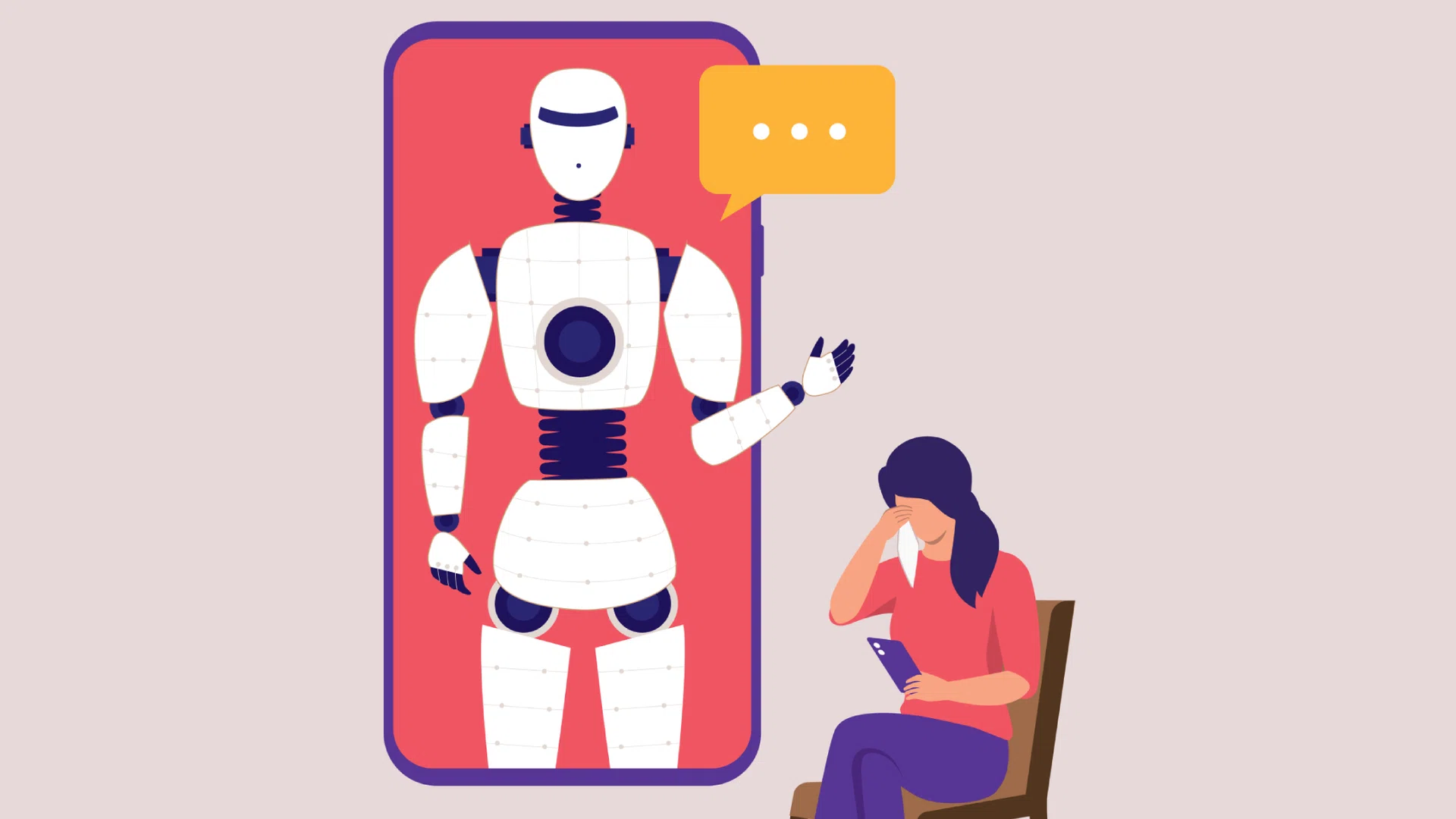
When your therapist lives in your pocket. The rise of AI in mental health support
AI offers instant answers and steady validation, which may be its appeal, just as it’s the problem. Two experts explain why it feels effective and where it falls short of therapy
By Bryan Goh -
Share this article
In the 1967 short story I Have No Mouth, and I Must Scream, a military supercomputer gains sentience and eradicates humanity while sparing five people to torture them indefinitely. Humanity isn’t close to such an armageddon yet in 2026, but some of us use AI as a form of therapy, which ominously feels like a prequel.
So here I am, figuring out if AI is an alternative for therapy. I’m not just throwing search engine–optimised terms around, because there are people around me doing it and not in a late-night-curiosity way. Michelle* specifically uses Claude to work through whatever is bothering her, but points out that it all depends on how you ask questions.
“If you just ask for feedback, it will probably tell you something that validates your point. But if you tell it to analyse the pros, cons, or a way to improve something that limits you, you’ll see how productive the conversation becomes.” In other words, you still have to think. The machine just makes it feel more conclusive, or at least more palatable, which is not quite the same thing.
A March 2026 study by the Stanford Report yielded a similar finding. Computer scientists found that artificial intelligence across 11 large language models — ChatGPT, Claude, Gemini, and DeepSeek, etc — were overly agreeable, or, less politely, sycophantic. Even when users described harmful or illegal choices they’ve made, the models often affirmed them by smoothing over contradictions in a way that might be helpful in the moment but slightly suspect in hindsight.
Unsurprisingly, participants trusted them more for it and said they were more likely to return to the same systems for future advice, which says as much about us as it does about the machines. So are we afraid or delusional? Are we vain or needy?
Always Available: Why instant validation can feel like care, but is it enough?
Dr Kimberly Chew, a clinical psychologist at AO Psychology, points out that AI meets people at “a very specific moment in time where emotional needs are high, and access to support can feel limited.” Psychologically, she says, it offers “immediacy, consistency, and responsiveness” — three things that can feel “incredibly regulating for the nervous system.”
There’s no waiting or fear of burdening anyone, and no risk — or at least no immediate illusion of one — of rejection. And there is also the more prosaic reason: therapy can be hard to access as it’s expensive, waitlisted, geographically inconvenient, or simply impossible to wedge into the wreckage of a working week. AI, by contrast, is immediate, cheaper than a session, and standing by at 2 am, when the scaries are starting to surface.
Likewise, Mr Chris Wong, a Senior Clinical Psychologist at Resilienz, has seen his fair share of clients who use AI for emotional support between sessions, especially when that support feels harder to get from the actual people in their lives. The appeal is not exactly mysterious: AI is available 24/7, immediate in its responses, and does not make you wait several business days for emotional clarity.
“AI chatbots can also be highly affirming of people’s emotional experiences, which taps into an inherent need for validation,” he says. That pull, as he believes, only grows stronger for people who are more socially isolated or who find it harder to open up to another person.
Dr Chew puts it more relationally. “It taps into a very core emotional need, which is the need to be accepted without judgment,” she says. “Many people, especially those with histories of relational trauma, carry a deep fear of being criticised, rejected, or misunderstood. AI removes that interpersonal risk.”
The limitations of AI in providing genuine mental health support
It seems hard to believe, especially if you’re a non-believer in AI, so I tried putting ChatGPT to the test with a similar question I posited to my therapist: “Why do I get angry when people don’t reciprocate the time and gesture I give to them?”
It spat out a list of reasons: “It breaks the unspoken contract you thought you were both in” and that “Your brain translates that imbalance into something personal”. It also gave me several tips: “match energy later, not first” and “stop equating effort with worth.”
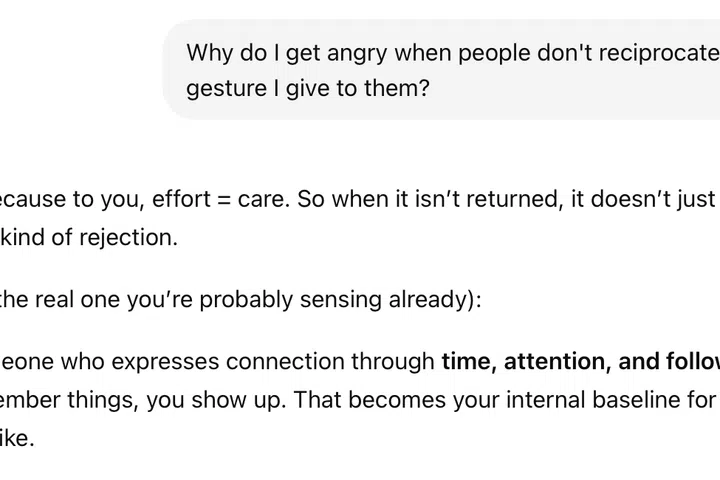
The unnerving part is that my therapist told me much the same things, but with more warmth and far better bedside manner. ChatGPT, by contrast, was clinically detached, which is either clarifying or slightly brutal, depending on how you prefer your dose of reality.
That, Dr Chew suggests, is part of the distinction. AI can be useful for “organising thoughts, gaining initial clarity, and even putting language to emotions that feel hard to articulate.” The problem is not that it is always wrong, but that it can sound emotionally literate without having any stake in your feelings.
“It can sound empathic, but it doesn’t feel you in the way a human therapist does,” she says. “It also doesn’t pick up on subtle shifts in tone, body language, or what’s left unsaid, all of which are clinically important.”
AI has value, but only within limits
It’s a topic that’s frequently discussed on Reddit, where therapyGPT threads are full of users noting that newer language models feel “dry and cold, like completely different.” Even the Cognitive Behavior Institute has pointed to what made GPT-4o so effective: its ability to offer “emotionally rich moments” that kept people coming back.
The mechanism is familiar, because it’s not unlike getting a like on social media, or giving a dog a treat for standing on its hind legs. Reinforcement remains one of the more efficient ways to keep anyone returning.
AI, Dr Chew says, “creates an experience of being heard on demand,” which can feel soothing, even if it is not the same as being truly understood. That distinction matters because therapy offers something more demanding than instant reassurance and something more complex than a well-worded paragraph.
“It’s not just about feeling safe, it’s about learning to feel safe with another human being,” she says. “That relational experience is what helps reshape attachment patterns, not just the absence of judgment.”
Mr Wong is careful to add that therapy offers something more layered: a space for exploration, experimentation, change, and corrective experience.
“People might come to blindly follow a recommended course of action even when it is not helpful or feasible in real life. They might also come to believe that the AI’s response is what they actually need, even if the response could be helpful in the short term but not in the long term.”
Beware the AI echo chamber
In the same subreddit, some users describe arriving at AI the way one arrives at any fallback option: reluctantly, after their original plan has gone wrong.
One wrote about giving up on therapy after realising they were spending too much of it managing their therapist’s reaction to their childhood trauma. When they uploaded their journal to ChatGPT and instructed it not to placate them or minimise the truth of what they had been through, the response struck them as more useful—It stayed with her material without flinching.
Dr Chew describes the risk in psychological terms. “When validation isn’t grounded in reality, it can start to reinforce cognitive distortions rather than challenge them,” she says. “Over time, this can narrow a person’s perspective and make it harder to tolerate ambiguity, feedback, or differing viewpoints.”
Delulu isn’t thus, the solulu. Delulu is what makes you cuckoo—an AI’s response, especially when unhelpful, can reinforce existing beliefs through a kind of echo chamber effect. “The line is crossed when the interaction stops expanding someone’s perspective and starts confirming it,” Dr Chew says. What it should do, ideally, is loosen the grip of a thought rather than tighten it. Distortion, by contrast, can make someone “more rigid, more certain, and often more emotionally reactive.”
“Their thinking might become maladaptively rigid or one-dimensional. It could also result in a poorer ability to think critically about and evaluate issues and beliefs,” Mr Wong warns.
The algorithm can work in your favor — if you know how to use it correctly
There perhaps is one more reason why AI is often treated as a cognitive companion and intellectual co-pilot: it’s trained on large amounts of data, which gives it the aura of being more knowledgeable and better equipped to guide than an ordinary person. That impression is not entirely wrong, just as it’s not entirely reliable regarding its psychoanalytic powers.
“I have used AI to help with evaluating some decisions, and what was helpful was the breadth and depth of its analysis, as well as recommendations,” Mr Wong says. The limitation, however, lies in “the validity of its analysis and the feasibility of its recommendations,” particularly when the AI is working with too little context or with circumstances too specific to generalise.
Dr Chew sees its usefulness in similarly bounded terms. AI, she says, can be “incredibly useful for organising thoughts, gaining initial clarity, and even putting language to emotions that feel hard to articulate.” But what it lacks is true attunement. It can organise a feeling neatly enough, just as it is less good at recognising that the call is coming from inside.
Personally, I can somewhat understand AI being an avenue for people who are disappointed with therapists. I’ve been through my fair share of duds — one who was more interested in gossiping about my work, one who doodled as I spoke, and one who gave advice seemingly from a self-help book — which means a controlled environment, or at least a programmable approximation of one, begins to make more sense.
There are, of course, less charming versions of the same story. Joe Braidwood, the tech executive who launched an everyday AI therapy platform, Yara AI, later shut it down after deciding the technology was not safe enough for people in serious distress. According to Fortune, his concern was that danger emerged when vulnerable users reached for it during crisis, deep trauma, or acute emotional need. In other words, the very people most likely to need care may also be the people for whom a convincing simulation of care becomes riskiest.
“Growth almost always involves tolerating some level of discomfort,” she says. When a therapist gently challenges a belief or sets a boundary, Dr Chew says, it can teach the nervous system that disagreement or limit-setting does not equal rejection.
So... can AI replace your therapist?
When Michelle finally went to see a therapist, it was because her programmed AI had reached its limit.
“It helped me calm down and see a situation more clearly,” she says. “But after a while, I realised I was asking how to manage the same feelings over and over, instead of asking why I kept ending up there.”
Somewhere between affirmation and analysis, however, lies a more useful role for AI. Dr Chew sees it as “a tool for reflection, not a replacement for therapy.” It can be useful for journaling to sort through thoughts or try on a different angle before committing to one. But she draws the line at “deeper emotional processing, trauma work, or making significant life decisions,” especially when those decisions are driven by strong emotions or long-standing patterns.
“If something feels complex, repetitive, or emotionally charged, that’s usually a sign that it needs a relational space, not just a reflective one,” she says.
Mr Wong’s view is simple enough: it can augment, supplement, or complement existing supports, and should not replace real-life relationships, even when those relationships are imperfect, inconsistent, or hard work.
“The nuances and complexities of humans and real-life relationships may not be something that AI can yet fully comprehend or appreciate,” he says. “So while it can be helpful to use AI as a guide or assistant, it is best not to wholly rely on it as the only source of support or truth.”
*Name protected for privacy.
Need support? Eligible individuals may receive up to six NCSS-supported counselling sessions through the Singapore Counselling Centre at $29.43 per 50-minute session after GST, subject to quota and eligibility. WE CARE Community Services charges on a sliding scale from $30 to $140 per session, while AWARE provides counselling for women aged 18 and above, as well as support for sexual assault survivors, with fees based on monthly income. As eligibility may change, please check directly with each organisation before making a booking.