%22%3E%3Cpath%20fill%3D%22%23000%22%20d%3D%22M79.702%2078.555c0%2033.03%2018.767%2046.361%2035.801%2046.361%2014.149%200%2029.738-7.033%2034.505-28.595l-1.445-.306c-3.61%2015.903-14.005%2027.371-33.06%2027.371-13.86%200-13.716-22.173-13.716-41.594V67.415h49.662c0-23.393-13.136-40.674-35.946-40.674-17.034%200-35.801%2018.94-35.801%2051.814m35.801-50.283c14.437%200%2014.005%2026.455%2013.861%2037.617h-27.573c-.004-18.353.865-37.617%2013.712-37.617%22%2F%3E%3C%2Fg%3E%3Cmask%20id%3D%22b%22%20width%3D%22603%22%20height%3D%22126%22%20x%3D%220%22%20y%3D%220%22%20maskUnits%3D%22userSpaceOnUse%22%20style%3D%22mask-type%3Aluminance%22%3E%3Cpath%20fill%3D%22%23fff%22%20d%3D%22M602.5%200H.5v125.074h602z%22%2F%3E%3C%2Fmask%3E%3Cg%20mask%3D%22url(%23b)%22%3E%3Cpath%20fill%3D%22%23000%22%20d%3D%22M86.81%20105.474h-1.445c0%2010.547-4.475%2011.463-5.483%2011.463-2.454%200-4.475-3.514-4.475-11.921V48.264c0-14.83-10.826-21.558-22.229-21.558-10.97%200-22.66%206.118-25.983%2017.276V8.478c-.515-4.763-4.26-8.48-8.893-8.48H.522v1.53H.5c2.886%200%204.763%201.988%204.763%205.045v110.211c0%203.057-1.877%205.045-4.763%205.045h.022v1.531h31.423v-1.531h.021c-2.885%200-4.762-1.988-4.762-5.045V50.252c0-10.395%208.949-18.806%2016.31-18.806%205.338%200%209.813%204.13%209.813%2014.83v58.74c0%2013.909%207.796%2019.874%2016.165%2019.874%209.958.005%2017.318-6.418%2017.318-19.416%22%2F%3E%3C%2Fg%3E%3Cmask%20id%3D%22c%22%20width%3D%22603%22%20height%3D%22126%22%20x%3D%220%22%20y%3D%220%22%20maskUnits%3D%22userSpaceOnUse%22%20style%3D%22mask-type%3Aluminance%22%3E%3Cpath%20fill%3D%22%23fff%22%20d%3D%22M602.5%200H.5v125.074h602z%22%2F%3E%3C%2Fmask%3E%3Cg%20mask%3D%22url(%23c)%22%3E%3Cpath%20fill%3D%22%23000%22%20d%3D%22M225.911%2042.197c0-10.552-11.259-16.818-22.954-16.818-10.682%200-21.513%205.045-25.119%2016.975v-7.352c-.48-4.574-3.977-8.148-8.364-8.398h-18.322v1.53h-.022c2.886%200%204.763%201.99%204.763%205.046v81.371h.004c.293%204.814%203.942%208.633%208.509%208.846v.004h18.173v-1.53h.022c-2.886%200-4.763-1.989-4.763-5.045V48.62c0-10.552%209.094-19.269%2016.602-19.269%204.763%200%208.805%203.672%209.386%2012.693%200%206.881%204.619%2011.773%2011.119%2011.773%206.631%200%2010.966-4.587%2010.966-11.62%22%2F%3E%3C%2Fg%3E%3Cmask%20id%3D%22d%22%20width%3D%22603%22%20height%3D%22126%22%20x%3D%220%22%20y%3D%220%22%20maskUnits%3D%22userSpaceOnUse%22%20style%3D%22mask-type%3Aluminance%22%3E%3Cpath%20fill%3D%22%23fff%22%20d%3D%22M602.5%200H.5v125.074h602z%22%2F%3E%3C%2Fmask%3E%3Cg%20mask%3D%22url(%23d)%22%3E%3Cpath%20fill%3D%22%23000%22%20d%3D%22M234.434%2028.315c2.925%200%205.583%202.312%206.779%205.863l29.782%2089.218h1.597l20.61-61.852%2020.609%2061.852h1.598l29.781-89.218c1.196-3.556%203.855-5.863%206.78-5.863h.183v-1.776h-11.538v1.776h.184c2.925%200%203.99%202.312%202.794%205.863l-18.082%2054.209-18.082-54.209c-1.196-3.556-.131-5.863%202.794-5.863h.183v-1.776h-33.343v1.776h.183c2.925%200%205.583%202.312%206.78%205.863l8.373%2025.058-9.705%2029.15-18.082-54.208c-1.196-3.556-.131-5.863%202.794-5.863h.184v-1.776h-33.344v1.776z%22%2F%3E%3C%2Fg%3E%3Cmask%20id%3D%22e%22%20width%3D%22603%22%20height%3D%22126%22%20x%3D%220%22%20y%3D%220%22%20maskUnits%3D%22userSpaceOnUse%22%20style%3D%22mask-type%3Aluminance%22%3E%3Cpath%20fill%3D%22%23fff%22%20d%3D%22M602.5%200H.5v125.074h602z%22%2F%3E%3C%2Fmask%3E%3Cg%20mask%3D%22url(%23e)%22%3E%3Cpath%20fill%3D%22%23000%22%20d%3D%22M377.826%20124.491c17.034%200%2038.211-15.699%2038.211-48.882%200-33.03-21.177-48.73-38.211-48.73-17.035%200-38.067%2015.857-38.067%2048.73.004%2033.026%2021.032%2048.882%2038.067%2048.882m0-96.085c13.86%200%2016.121%2028.24%2016.121%2047.356%200%2019.116-2.261%2047.198-16.121%2047.198-13.861%200-15.978-27.777-15.978-47.198%200-19.422%202.122-47.356%2015.978-47.356%22%2F%3E%3C%2Fg%3E%3Cmask%20id%3D%22f%22%20width%3D%22603%22%20height%3D%22126%22%20x%3D%220%22%20y%3D%220%22%20maskUnits%3D%22userSpaceOnUse%22%20style%3D%22mask-type%3Aluminance%22%3E%3Cpath%20fill%3D%22%23fff%22%20d%3D%22M602.5%200H.5v125.074h602z%22%2F%3E%3C%2Fmask%3E%3Cg%20mask%3D%22url(%23f)%22%3E%3Cpath%20fill%3D%22%23000%22%20d%3D%22M490.482%2042.197c0-10.552-11.258-16.818-22.953-16.818-10.683%200-21.513%205.045-25.119%2016.975v-7.352c-.48-4.574-3.977-8.148-8.365-8.398h-18.326v1.53h-.022c2.886%200%204.763%201.99%204.763%205.046v81.371h.004c.293%204.814%203.943%208.633%208.509%208.846v.004h18.173v-1.53h.022c-2.885%200-4.763-1.989-4.763-5.045V48.62c0-10.552%209.094-19.269%2016.602-19.269%204.763%200%208.806%203.672%209.386%2012.693%200%206.881%204.619%2011.773%2011.119%2011.773%206.64%200%2010.97-4.587%2010.97-11.62%22%2F%3E%3C%2Fg%3E%3Cmask%20id%3D%22g%22%20width%3D%22603%22%20height%3D%22126%22%20x%3D%220%22%20y%3D%220%22%20maskUnits%3D%22userSpaceOnUse%22%20style%3D%22mask-type%3Aluminance%22%3E%3Cpath%20fill%3D%22%23fff%22%20d%3D%22M602.5%200H.5v125.074h602z%22%2F%3E%3C%2Fmask%3E%3Cg%20mask%3D%22url(%23g)%22%3E%3Cpath%20fill%3D%22%23000%22%20d%3D%22M602.5%20103.974h-1.445c0%2010.553-4.474%2011.468-5.483%2011.468-2.453%200-4.474-3.519-4.474-11.925V6.585c0-3.056%201.877-5.045%204.762-5.045h-.166V.01h-17.715c-4.942%200-8.953%204.24-8.962%209.475h-.009v23.333c-6.063-3.977-9.84-5.503-16.48-5.503-17.034%200-35.801%2014.169-35.801%2047.046%200%2033.183%2013.101%2050.718%2035.801%2050.718%208.085%200%2013.302-2.294%2019.942-8.254%203.03%204.587%207.797%206.575%2012.704%206.575%209.966-.004%2017.326-6.427%2017.326-19.426m-30.75%2011.625c-4.763%204.435-10.84%205.822-13.38%205.822-11.482%200-19.558-16.933-19.558-46.907%200-29.97%2010.914-43.222%2019.885-43.222%203.3%200%206.264.153%2010.307%203.057v69.172c.004%205.04%201.017%209.017%202.746%2012.078%22%2F%3E%3C%2Fg%3E%3Cmask%20id%3D%22h%22%20width%3D%22603%22%20height%3D%22126%22%20x%3D%220%22%20y%3D%220%22%20maskUnits%3D%22userSpaceOnUse%22%20style%3D%22mask-type%3Aluminance%22%3E%3Cpath%20fill%3D%22%23fff%22%20d%3D%22M602.5%200H.5v125.074h602z%22%2F%3E%3C%2Fmask%3E%3Cg%20mask%3D%22url(%23h)%22%3E%3Cpath%20fill%3D%22%23000%22%20d%3D%22M516.984%20121.865c-2.885%200-4.763-1.988-4.763-5.045V9.466C512.2%204.241%20508.196.01%20503.259.01h-17.724v1.53h-.022c2.89%200%204.763%201.989%204.763%205.045v108.418c.515%204.564%204.029%208.129%208.434%208.337v.06h18.252v-1.53h.022z%22%2F%3E%3C%2Fg%3E%3C%2Fsvg%3E)
From void decks to the runway: How $900 slippers made their way to the front row
Once the footwear of last resort, The Row’s rubber sandals have been crowned one of the season’s most coveted shoes – and, yes, they look exactly like what you wore to the kopitiam
By Elise Wong -
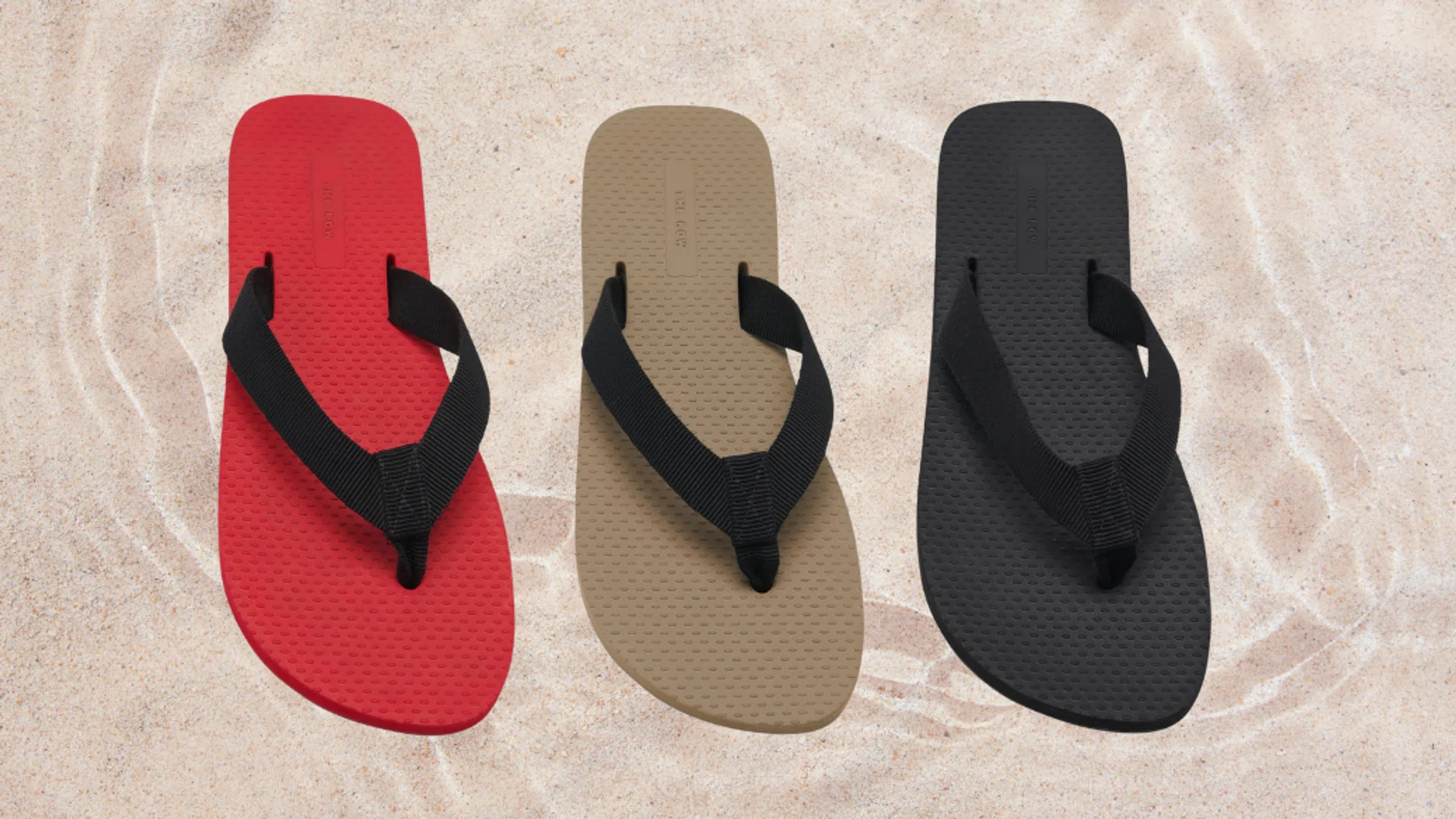
They look like something you’d wear to take out the trash. Flat soles, black grosgrain straps, a slight curve of utilitarian indifference. There’s nothing about The Row’s Dune sandals that screams luxury – until you see the price: US$690, or nearly S$900. And by then, they’re already sold out.
The sandals – along with the brand’s Sock Mesh Flats, which resemble the water shoes you wore for the entirety of OBS – have been spotted on the feet of Kendall Jenner, Zoe Kravitz, and other alumni of the stealth-wealth sorority. They come unembellished, unassuming, and unapologetically plain.
Unsurprisingly, their function isn’t to impress.
For a label built by two former child stars Mary-Kate and Ashley Olsen, The Row has always been defined by erasure – of logos, trends, noise. Its pieces don’t posture, but retreat. And it is in that retreat that value is manufactured. It is a fresh kind of flex – the fashion equivalent of a whisper heard over a screaming endorsement.
But this season, that whisper has taken the form of a rubber slipper – the very kind your mom used to threaten to throw at you – and somewhere in the back of a Singaporean MRT carriage, someone’s laughing.
More than just a slip-up
Fashion’s long-standing fascination with the banal is anything but new. It has mined the everyday with precision: Dickies as streetwear, Juicy as nostalgia, Crocs as irony. What was once practical becomes covetable – provided it’s filtered through the right face, with the right styling, at the right time, and more importantly, the right zip code.
The Dune sandals are only the latest in this cycle. Their resemblance to a dorm room staple or a void deck essential isn’t coincidental but, unfortunately, the point. In a TikTok clip with over 2.5 million views, a fashion commentator holds up the shoe and asks: “Do people know I’m wearing flip-flops in a Carolyn Bessette-Kennedy, Olsen Twins kind of way? Or do they think I’m just wearing flip-flops?”
Since its founding in 2005, The Row has stood as a blueprint for a new kind of understated luxury – indulgent, sculptural, and unmistakably timeless. Nearly two decades on, its aesthetic is instantly recognisable to the informed eye: cocooning silhouettes, exceptional craftsmanship, and a quiet sophistication that has been much imitated by its label peers.
Despite its sky-high prices, The Row eschews almost all forms of overt branding – save for a discreet name tape on the collar or the faintest hint of a logo. Yet few could have predicted just how influential the label would become.
Its stealth success is, in many ways, shaped by the lives of its founders. Cast as infants in the 90’s sitcom Full House, Mary-Kate and Ashley Olsen grew up under relentless public scrutiny, later becoming tween icons and fashion muses of the early internet era. But it was precisely this media saturation that prompted them to retreat from the public eye – and in doing so, shaped the DNA of their brand.
From the outset, The Row rejected the spectacle of celebrity fashion. The first collection – launched quietly in 2006 when the twins were just 20 – consisted of six elevated basics, including the now-mythic white T-shirt. Anonymity was, and still is, the brand’s modus operandi.
Now, with a reported $1 billion valuation as of late 2024, and new investment from luxury power players including the Wertheimer family (Chanel), Natalie Massenet (Net-a-Porter), and Lauren Santo Domingo (Moda Operandi), The Row is something akin to a quiet juggernaut.
Predictably, the Dune fits into this universe with almost comical precision. With their flat red soles and simple black straps, they look like Havaianas flip-flops run through a $1,000 branding filter – not just minimalist-leaning, but aggressively, well, blank.
Nevertheless, logic is rarely universally applied – the same pair that earns praise in a Marylebone boutique would, perhaps, earn a side-eye at the Marina Bay Sands. Your favourite open-toed slides – now, apparently, high-fashion in Copenhagen – are still the punchline of countless “lazy, underdressed boyfriend” jokes in Singapore.
The timing is rich. While international headlines gush over these “unexpectedly chic” rubber sandals, Singaporeans have long worn them to the hawker, the kopitiam, the 7-Eleven for a late-night Slurpee. We kick them off at thresholds, swap them out under office desks, stuff them in the side pouches of our bags “just in case”.
They’ve accompanied us through humid commutes, polytechnic hallways, and the occasional restaurant-slash-bar standoff where “No Slippers Allowed” signs attempt to restore imagined decorum. Yet, despite their ubiquity – or because of it – they’ve rarely been aspirational. Until now.
Not quite a flop
To some, the sitch is as straightforward as a joke in terrible taste.
“Disrespectfully, what are we doing? We have lost the plot,” says one invested TikTokker, frowning beneath a product shot of the Dune. To others, it’s a stroke of brilliance – a perfect example of how branding, limited availability, and the elevation of the ordinary can be turned into marketing gold.
Hark back to the absurdity of Balenciaga’s US$925 (~S$1,200) towel skirt – the sartorial equivalent of f*** you money. It was never really about the towel itself. It was about the audacity. The price tag dared you to question its value. That was the point.
So, get this – The Row knows exactly what it’s doing. The Dune’s rise is part of fashion’s long-standing habit: co-opting the mundane, stripping it of its original context, and reselling it at 10 times the price. From iterations of indigo jeans to Juicy Couture, luxury routinely raids the wardrobes of the everyday, strips them of context, and resells them at a premium.
As one fashion analyst on TikTok put it, “Pricing isn’t a commercial reality… [it’s] more of a communication strategy.” The Dune absolutely does not – it could not – cost $900 because of its materials. It costs $900 because it has to. Not charging that would confuse the message – of taste, exclusivity, and a kind of self-aware, rarefied discernment.
Even The New York Times found itself torn between admiration and ridicule: Ultimately, they are an under-$1,000 way to buy into the world of the Olsens and their top customers. Certainly, to wear The Row is to demonstrate understanding – fluency – in the language of fashion.
That’s the paradox. The Dune doesn’t stand out. It blends in – and in doing so, in being recognisable only to those fluent in the language of fashion, it stands far taller than any logo could.
Maybe we were first
It can be tempting to dismiss it all as another absurd turn in fashion’s endless ouroboros. Still, the Dune reveals more than just the cyclical appetite for “ugly” shoes. Because if a slipper can be chic in New York but it’s considered sloppy to let the dogs out at Orchard Road, it’s not the slipper that changed – taste, after all, isn’t innate, but inherited.
Our $2 blue-white-black Tat Sing slippers were everywhere in ‘90s Singapore – paired with uncle wife-beaters, ‘Good Morning’ towels, and all the kopitiam bravado you could ask for. That look? It’s etched deep in our cultural DNA.
Today, you could pay S$900 for The Row – if you can get your hands on them. Or $5 for a pair of Tat Sings online.
Principally, there’s no difference at all. There’s no need for a rebrand to wear those flip-flops with pride. Just a bit of perspective – or, perhaps, a very, very expensive marketing team.
If that’s the case, maybe we’ve been ahead of the curve all along.